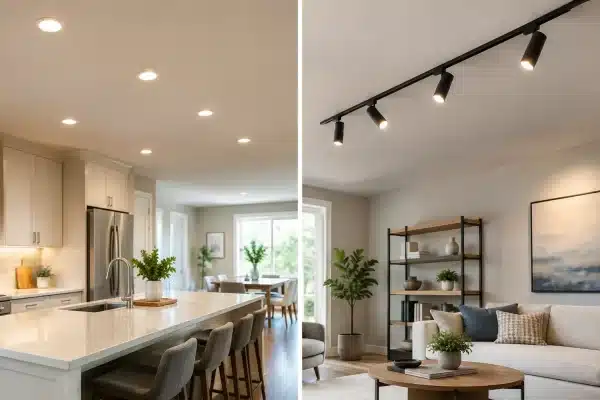
A beautiful kitchen can still feel flat when its lighting is doing only one job. This is where the choice between downlights versus track lighting becomes more than a technical detail: it decides whether a room feels quietly polished, deliberately dramatic or properly equipped for everyday life.
Both options can deliver bright, efficient LED illumination. The difference lies in how they shape the space. Downlights disappear into the ceiling for a clean, architectural finish. Track lighting stays visible, becoming part of the design while giving you the freedom to aim light exactly where it earns its place.
Downlights versus track lighting: the essential difference
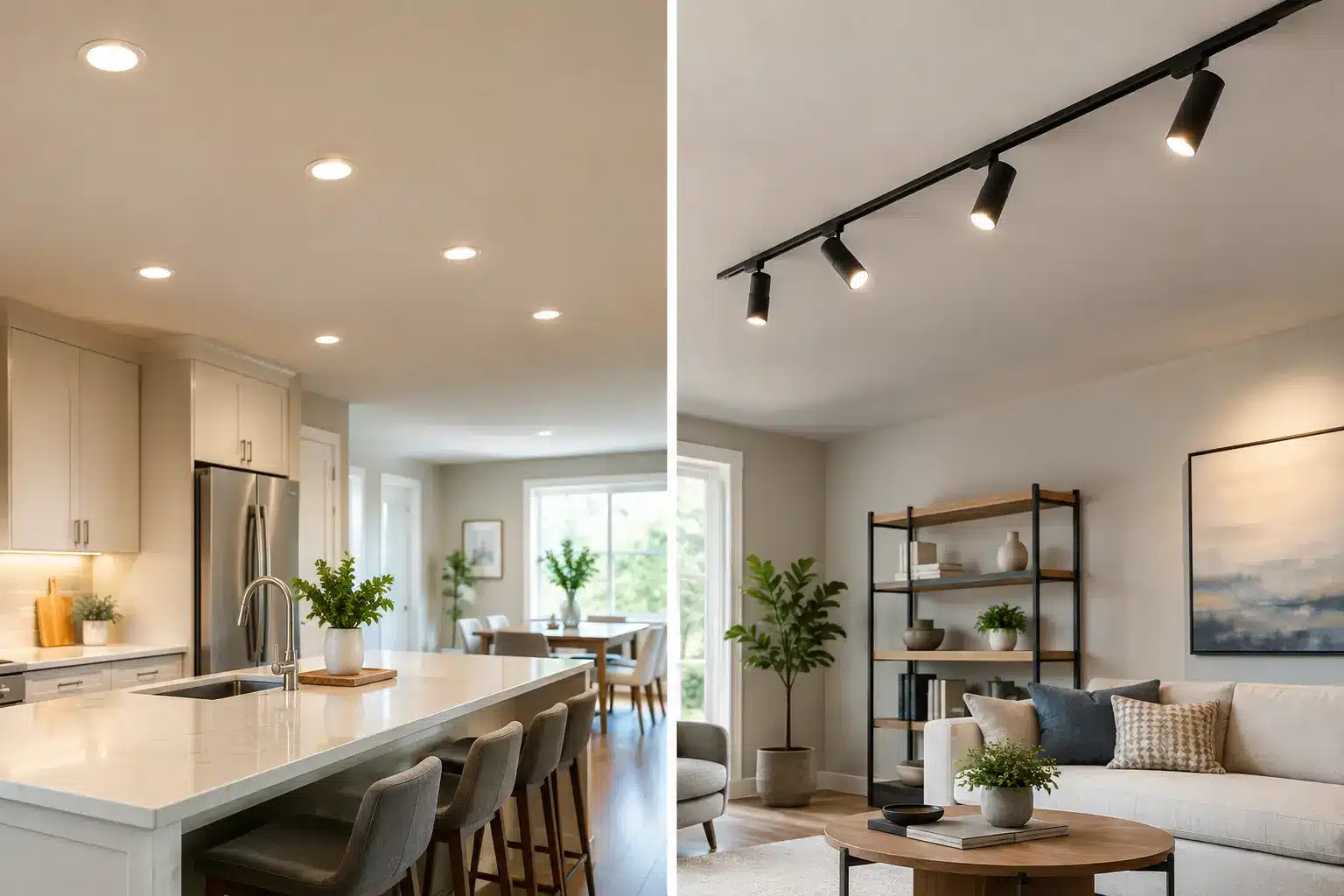
Downlights are recessed fittings set into the ceiling. Their light is directed downwards, usually in a fixed pool, making them ideal for a neat layer of general light or focused task lighting. When positioned well, they create an uncluttered ceiling line that lets cabinetry, artwork and statement pendants take centre stage.
Track lighting consists of adjustable spotlights mounted along a surface-mounted or recessed track. Each head can be turned and tilted independently, allowing you to wash light across a wall, pick out a painting, brighten open shelving or direct useful light on to a worktop. It has a more expressive, contemporary character and suits spaces where the layout or focal points may change.
Neither is automatically the better choice. A low-ceilinged galley kitchen, a period sitting room and a busy café each ask for something different. The strongest schemes often use both, with every fitting assigned a clear purpose.
Choose downlights for a clean, considered ceiling
Downlights are popular for good reason. They can make a room feel calm and spacious, particularly when the ceiling should remain visually quiet. In a modern kitchen, evenly spaced downlights provide reliable ambient light without competing with feature pendants over an island or dining table.
They also work beautifully in bathrooms, hallways, utility rooms and dressing areas, where practical illumination matters more than a decorative fitting. In bathrooms, always select the correct IP rating for the location, especially around showers and baths. Your electrician can advise on the appropriate zones and installation requirements.
The key to good downlighting is planning, not quantity. A ceiling covered in tightly packed fittings can feel harsh and clinical, especially if each lamp has a narrow beam or a cool white colour temperature. Instead, think about where people stand, prepare food, read, get dressed and move through the room. The light should support those moments rather than simply fill every inch of ceiling.
For most living spaces, warm white light creates a more inviting feel. Dimmable downlights add another layer of control, taking a kitchen from bright breakfast preparation to a softer evening setting without changing the whole scheme.
Where downlights work best
Downlights are especially effective in rooms with a straightforward layout and a need for consistent illumination. They suit kitchens with wall and base units, bathrooms requiring a tidy finish, hallways where low-profile lighting is useful, and open-plan areas that need a discreet background layer.
They can also highlight architectural features when placed at the right distance from a wall. This is called wall washing: rather than pointing light directly at the floor, the fitting throws light down the vertical surface, helping texture, colour and artwork feel more present. Placement and beam angle matter here, so it is worth considering the wall finish before the ceiling is cut.
Choose track lighting for flexibility and visual impact
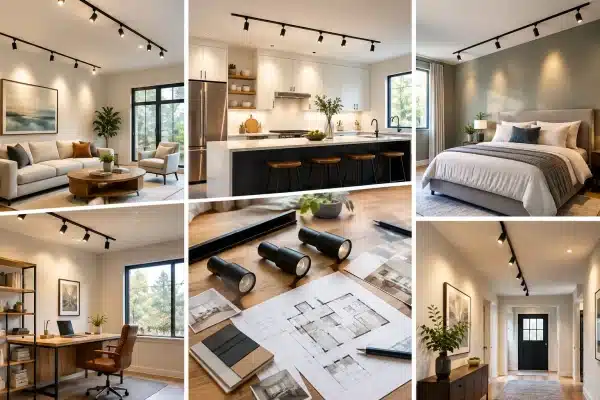
Track lighting brings movement, direction and personality. It is an excellent option when one ceiling fitting needs to do several jobs: brighten a food-prep area, illuminate framed prints and add depth to a darker end of the room. Adjustability makes it particularly useful in renovated homes, where furniture positions and room uses are still evolving.
A slim black track can add crisp definition to a pale contemporary kitchen. Brass or warmer metallic finishes can soften the look in dining spaces and boutique-style bedrooms. White track lighting can blend into a white ceiling while still giving you the practical benefit of moveable spotlights.
In commercial interiors, track lighting is a natural choice for retail displays, hospitality spaces and reception areas. It allows a display to be refreshed without rewiring the room each time. The same principle works at home: rotate a spotlight to a new piece of art, a reading corner or an open shelf, and the room gets a subtle new focal point.
Track is not always the quieter choice. The fitting remains visible, which is precisely why it suits homes where lighting is part of the interior story. If your style leans minimal but not bland, an elegant track can look intentional rather than intrusive.
Where track lighting earns its place
Consider track lighting in kitchens with artwork, open shelving or a long island; living rooms with several zones; loft-style spaces; converted properties; and home offices that need adaptable task light. It can also be a practical answer where recessed fittings are difficult to install because of concrete ceilings, limited ceiling voids or insulation considerations.
One well-positioned track may replace several separate surface fittings, though the number of heads and their beam spreads still need careful thought. A track with too few spotlights can leave unhelpful shadows, while too many narrow beams can create a busy, high-contrast effect.
Light quality matters as much as the fitting
The housing style is only one part of the decision. Beam angle, brightness, colour temperature and colour rendering will determine how a room actually feels once the lights are switched on.
A narrower beam is useful for highlighting artwork, a breakfast bar or a decorative wall. A wider beam gives a softer spread for general illumination. In a kitchen, combine broad ambient light with more focused task light on worktops. In a sitting room, keep the overall level gentler and use adjustable heads or table lamps to build atmosphere around seating.
Look for good colour rendering if you want finishes, food and fabrics to appear natural. This is especially worthwhile in kitchens, bathrooms, dressing areas and hospitality settings, where pale stone, timber grains and paint colours should look as considered at night as they do in daylight.
Dimming is another detail that changes everything. Make sure the fittings, bulbs, driver and dimmer switch are compatible. A well-designed dimmable scheme gives you far more value from the same lights, allowing one room to feel energetic for cooking and relaxed for entertaining.
Installation, ceilings and future flexibility
Downlights require holes in the ceiling, plus suitable clearance above the fitting. This can be straightforward during a renovation or new build, but needs more care where insulation, joists or existing wiring are involved. Fire-rated downlights are often chosen where the ceiling forms part of a fire barrier, and an electrician should confirm what is required for your property.
Track lighting is generally easier to access and alter later because the heads remain on the surface. It may be a more forgiving option for an older property or a ceiling where recessing fittings is impractical. That does not mean it is a shortcut: the track should still be positioned neatly, proportioned to the room and wired by a qualified professional.
If you are planning a larger project, decide on lighting before plastering, decorating or ordering joinery. It is far easier to place a downlight away from a cupboard door or centre a track over an island when the room is still on paper.
A layered scheme often looks best
Relying on downlights alone can make a beautifully furnished room feel overly uniform. Relying on track lighting alone can leave it feeling too directional. Layering creates the warmth and depth people notice, even if they cannot immediately explain why.
Use recessed downlights for a discreet base layer, track heads for features or flexible task lighting, and decorative pendants, wall lights or lamps for character. In a kitchen-diner, for example, downlights can cover circulation and worktops, a pendant can anchor the island, and a short track can highlight art or a drinks area. Each element has a job, so the room feels composed rather than crowded.
For a home renovation, Lux Lighting can help turn those early decisions into a more cohesive lighting plan, particularly where bespoke LED strip lighting or several connected spaces are involved.
Which should you choose?
Choose downlights when you want a recessed, understated finish and a consistent layer of practical light. Choose track lighting when you want adjustability, visible design detail and the ability to direct attention around the room. If you want a scheme that feels genuinely finished, do not treat the decision as either-or.
Start with how you use the room after dark. Then choose fittings that make the work surfaces clear, the seating inviting and the details you love worth looking at.