A staircase can be beautifully finished, perfectly painted and still feel unfinished after dark. The right top stair lights that Irish homeowners choose do more than help people see the next step: they give a hallway depth, make a landing feel considered and bring a quietly luxurious finish to a renovation.
Stair lighting works best when it is planned as part of the space, rather than added as a last-minute safety feature. Whether you are updating a narrow hall, designing a new-build home or fitting out a hospitality setting, the most successful scheme balances practical illumination with a clean, unobtrusive look.
What makes a stair light the right choice?
There is no single best fitting for every staircase. A compact recessed light may suit a crisp contemporary hall, while a surface-mounted fitting can be the sensible option where chasing walls is not possible. LED strip lighting under a handrail can create a striking floating effect, but it requires a neater installation and careful attention to where the driver will sit.
Start with the architecture of the stairs. Open-riser staircases benefit from soft light that defines each tread without spilling harshly across the room. Enclosed stairs often need a little more guidance on the wall, especially around turns and at the bottom landing. If the staircase is a feature within an open-plan space, decorative impact matters just as much as visibility.
The aim is not to flood the area with brightness. Strong overhead lighting can cast deep shadows from a person’s body and make a stairwell feel flat. Low-level fittings create a gentler pool of light exactly where it is needed, while leaving the wider scheme calm and inviting.
Top stair lights in Ireland: the styles worth considering
Recessed wall lights for a built-in finish
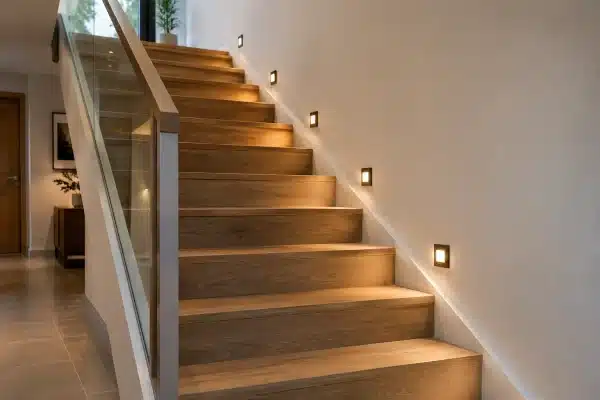
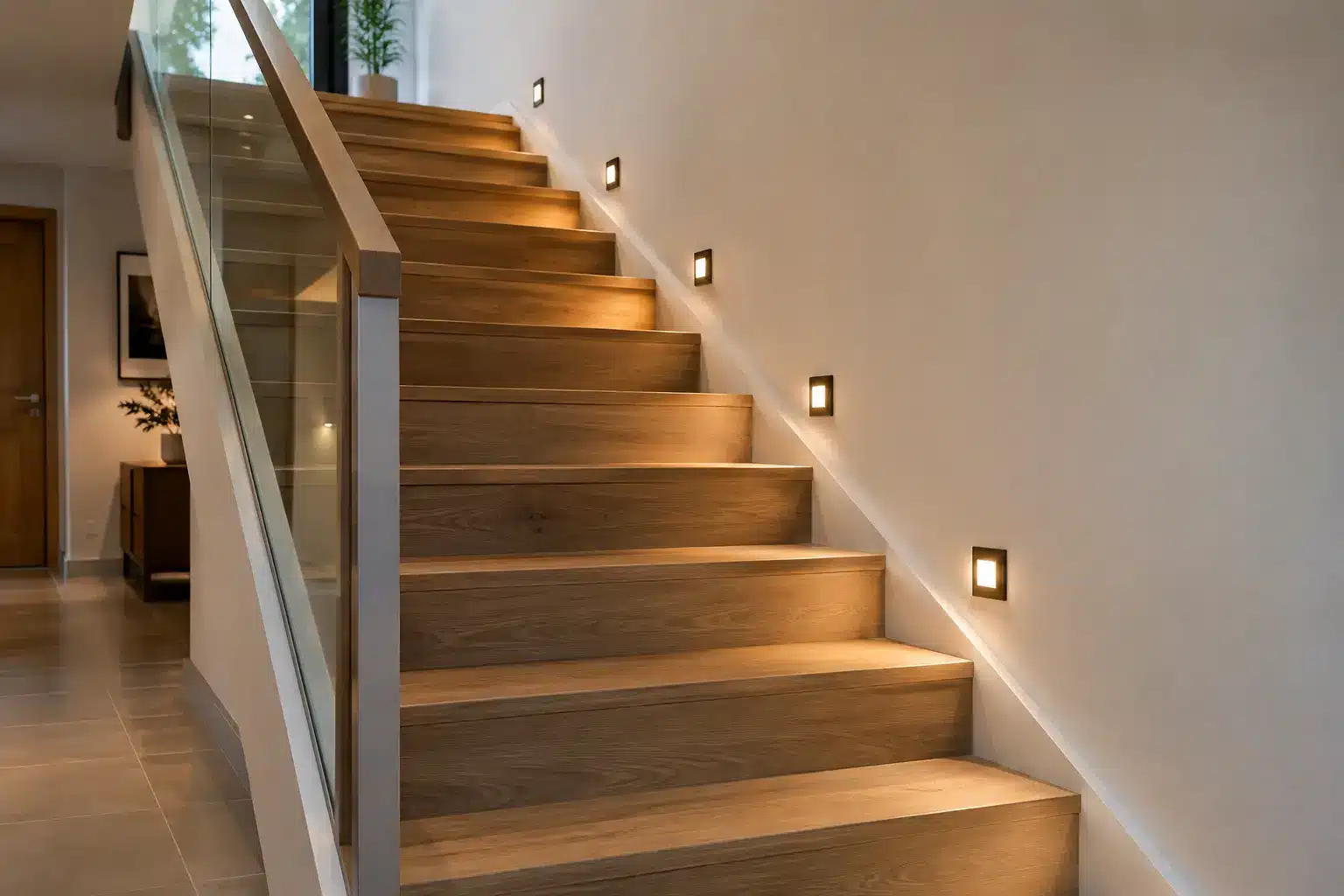
Recessed stair lights sit within the wall beside the steps, leaving the surface clear and visually streamlined. They are an excellent choice for contemporary homes, plastered feature walls and projects where the staircase is being built or refurbished from scratch.
Look for fittings with a louvred or hooded front. These direct light downwards over the tread rather than into someone’s eyes as they climb. A warm white output, typically around 2700K to 3000K, gives timber, carpet and painted finishes a softer, more welcoming appearance than a cool white lamp.
The trade-off is installation. Recessed fittings need sufficient wall depth, accurate cut-outs and coordination with the electrician before final plastering or decorating. They are worth the effort when a minimal finish is the priority, but may not be practical for every existing stairwell.
Surface-mounted lights for straightforward upgrades
Surface-mounted step lights attach directly to the wall, so they are often the easier route when renovating an existing home. Available in understated black, white, brushed metal and contemporary geometric forms, they can look intentionally designed rather than like an afterthought.
These fittings suit solid walls where recessing would be disruptive, as well as stairs with limited cavity space. Choose a compact profile and downward-facing light source to keep circulation areas comfortable. On a very narrow staircase, avoid a fitting that projects too far from the wall, particularly at hip height or near a turn in the stairs.
Surface fittings also make future maintenance simpler. If you prefer the reassurance of an accessible fitting, this style offers a practical balance of style, serviceability and low-level guidance.
LED strip lighting under handrails or treads
LED tape is the option with the greatest design potential. Installed beneath a handrail, it makes the line of the stairs appear to float. Placed under tread nosings, it can define every step with a refined, architectural glow. It is particularly effective on open staircases, timber joinery and bespoke interiors where the lighting should feel integrated rather than visible.
Quality matters here. The strip should sit in an aluminium profile with a diffuser, rather than being stuck directly onto timber or plaster. This protects the tape, improves heat management and prevents the dotted appearance of individual LEDs. A well-chosen diffuser produces an even ribbon of light that looks polished day and night.
This approach needs planning. Consider where the power supply, controller and access point will be located before the joinery is fitted. For longer runs, a bespoke LED solution can help ensure consistent brightness from the first step to the last. It is also the ideal route for complex stairs, multiple landings or a scheme that continues into a hallway or living space.
Compact lights for risers and plinths
Small recessed lights set into stair risers or the plinth wall create a discreet hotel-inspired effect. They work especially well where the side wall is not available for fittings, or where you want light to appear to come from the staircase itself.
Spacing is crucial. A fitting on every step may be right for a dramatic commercial setting, but it can feel overly busy in a home. Lighting every second or third step often gives enough definition while preserving a relaxed atmosphere. Your final spacing should account for the stair width, the fitting’s beam spread and any changes in direction.
Plan brightness, colour and control together
A stair light should guide, not glare. Low-wattage LEDs are usually enough, particularly when several fittings share the task. The exact output depends on the fitting design and wall colour, but the visual test is simple: each tread and change in level should be easy to read without the source feeling uncomfortably bright.
Warm white is the natural choice for most homes. It sits beautifully alongside timber flooring, brass details, soft neutral paints and warm decorative pendants in the hall. Neutral white can suit a crisp, commercial or highly modern scheme, but cooler light can make a domestic staircase feel less inviting.
Controls deserve as much thought as the fittings. A sensor is useful for stairs used at night, allowing the lights to come on at a low level when someone enters the hall. Dimming gives more flexibility in a family home, especially if the stair lighting is part of a wider evening scene. For smart lighting, check compatibility between the fittings, driver, dimmer and control system before ordering. Not every LED product dims in the same way.
Safety and installation details that should not be overlooked
Stair lights are a design feature, but they are also part of a safe route through the home. Position them consistently, especially near the first and last steps, landings and any change of direction. Avoid strong pools of light followed by dark gaps, as uneven lighting makes it harder to judge depth.
Any mains electrical work should be completed by a qualified electrician. This is particularly relevant for recessed units, LED drivers concealed in joinery and smart control systems. If your staircase is close to an external door, utility area or another damp location, ask about the appropriate IP rating for the fitting and its placement.
Think about maintenance before walls are closed up. Integrated LED fittings can offer a very clean look and long life, yet replacement arrangements differ by product. With LED tape, ensure the driver remains accessible. A small access panel inside a cupboard or under-stairs storage area can save considerable disruption later.
Make stair lighting part of the wider hall scheme
The most considered staircases do not rely on one source alone. Low-level step lighting provides guidance, while a decorative pendant, wall light or ceiling fitting brings character to the hall. Together, they create layers: practical light underfoot, flattering ambient light around the space and a focal point that sets the tone on arrival.
Match finishes where possible, but do not force everything to be identical. Matte black stair lights can sit confidently with a warm brass pendant if the overall palette has a clear purpose. Likewise, a minimal white recessed fitting can disappear into a pale wall while allowing a statement staircase or artwork to take attention.
For an awkward layout, a period property or a detailed joinery plan, specialist advice is often the difference between a good result and a genuinely finished one. Lux Lighting can help turn an initial idea into a scheme that considers fitting type, placement, LED profiles and the atmosphere you want to create.
Choose the style that suits how your stairs are built, then give the installation the same care as the finish. When the lights come on in the evening, the staircase should feel safer, calmer and like it has always belonged to the home.