The wrong ceiling light can make a beautifully organised desk feel like the least inviting corner of the house. It can cast shadows across your keyboard, flatten your face on video calls or leave you squinting by mid-afternoon. The best home office ceiling lights do more than brighten the room: they create a comfortable working atmosphere, support concentration and make your workspace feel properly considered.
Whether you work from a dedicated study, a spare bedroom or a compact desk nook, the ceiling fitting is the foundation of your lighting scheme. Get that layer right and task lighting, decorative details and your screen all work together far more effectively.
Start with the way you use the room
A home office used for a few admin tasks each week needs something different from a room where you spend eight hours a day meeting clients, drawing plans or editing on screen. Before choosing a fitting, consider when you work, where daylight enters and whether the room also needs to function as a guest room, dressing room or family space.
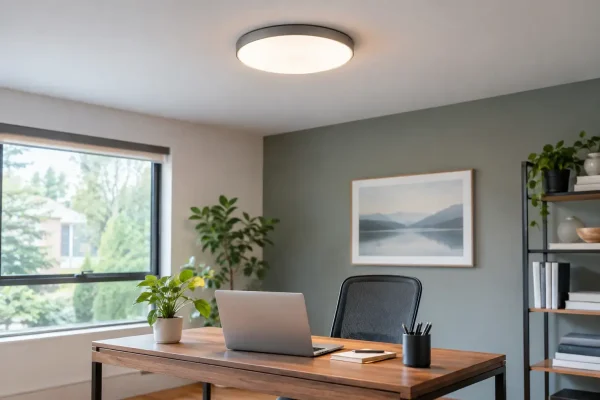
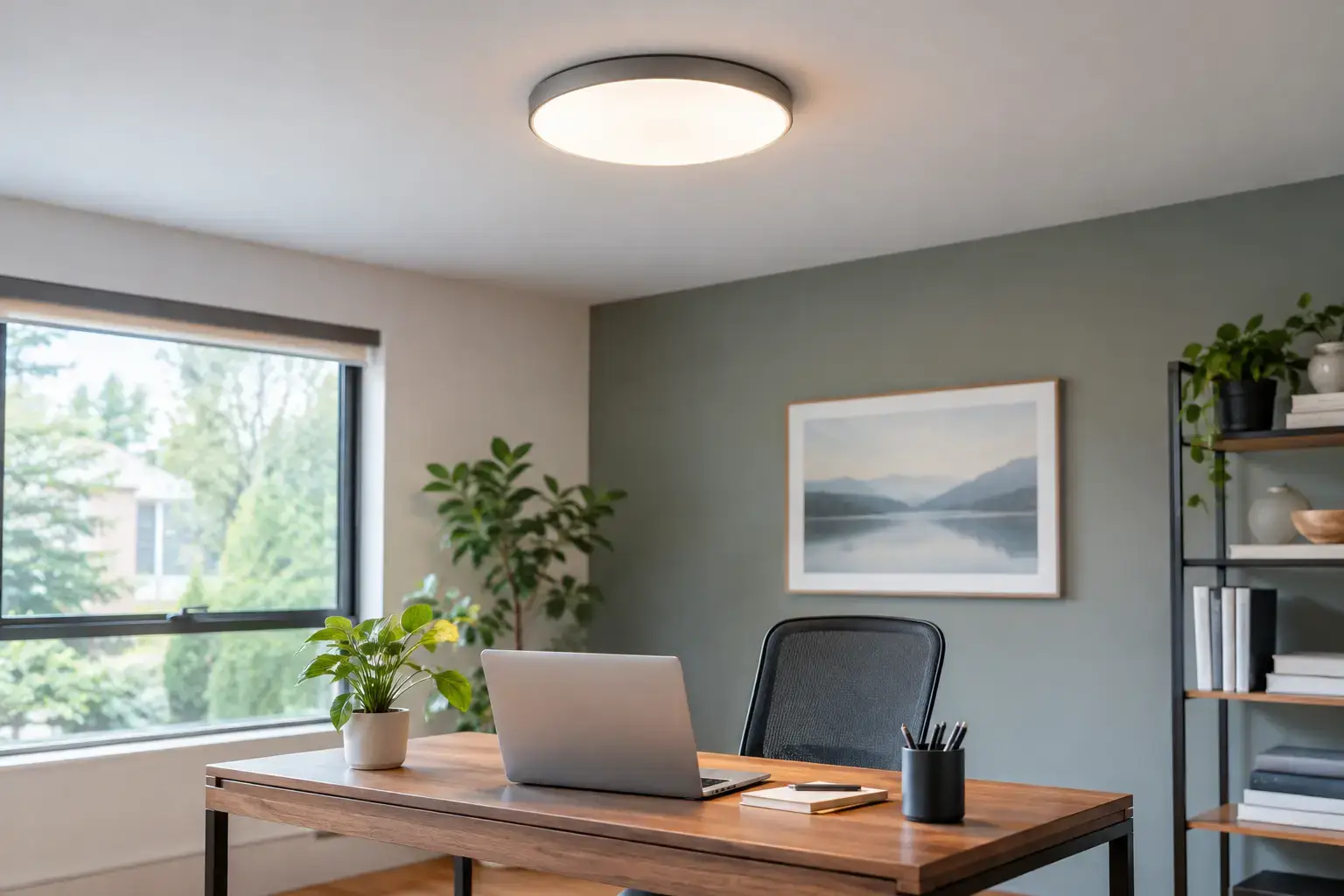
For a desk positioned beneath the centre of the room, a wide flush ceiling light or a low-profile LED fitting often gives the most even coverage. In a small office, it avoids visual clutter and keeps headroom clear. A larger study can carry more presence, perhaps with a decorative semi-flush fitting or a carefully chosen pendant that introduces texture and character.
The key is not simply adding more brightness. Too much direct light can feel clinical, while too little will make focused work tiring. Aim for a balanced base layer that fills the room without creating sharp pools of light or dark corners.
Choose the right home office ceiling lights for the layout
Flush and semi-flush fittings for everyday flexibility
Flush ceiling lights sit close to the ceiling, making them a strong choice for lower ceilings and compact rooms. They are practical, unobtrusive and available in finishes that still make a design statement, from soft opal glass to matt black, brass and contemporary ribbed details.
Semi-flush lights hang slightly lower. This small drop can add a more decorative profile while remaining sensible in rooms where a full pendant would sit too low. They suit homeowners who want their office to feel connected to the rest of their interior rather than purely functional.
Look for diffused shades or integrated LED designs that spread light across a broad surface. Clear exposed bulbs can look striking, but in a work setting they may produce glare, particularly when your desk is directly below the fitting.
Recessed spotlights for clean, tailored schemes
Recessed spotlights offer a neat architectural finish, especially in renovated studies, loft conversions and rooms with a contemporary built-in desk. They are excellent for distributing light across the room, and their discreet appearance lets shelving, artwork or joinery take centre stage.
Positioning matters. A grid of downlights directly above a screen or desk can create unwanted reflections and shadows. Instead, use them to wash the perimeter of the room, illuminate storage and provide general coverage. Adjustable spotlights can be useful near bookcases or display shelves, but avoid aiming them straight towards your face or monitor.
This option works particularly well when paired with a desk lamp. The ceiling spots establish ambient light, while the lamp gives you controlled illumination where you read, write or work with detail.
Pendant lights for a more expressive workspace
A pendant can make a home office feel intentional, especially where the room has generous ceiling height. It is also a chance to introduce a finish seen elsewhere in the home, such as warm brass, smoked glass, natural rattan or a bold sculptural shade.
There is a trade-off. A pendant hanging over the centre of a desk can be visually impressive but may interrupt sightlines, especially during video calls, or throw a shadow when you lean forward. It often works better offset over a reading chair, meeting table or open area, with practical task lighting at the desk itself.
Choose a shade that softens the bulb rather than leaving it fully exposed. Opal glass and fabric-style shades can create a calmer glow, while metal shades direct light downwards and are better suited to a specific work surface than whole-room lighting.
Get the colour temperature right
Bulb colour has a noticeable effect on how an office feels. For most home workspaces, neutral white light around 4000K provides a crisp, clear quality without becoming harsh. It works particularly well for daytime working, paperwork and tasks that need accurate colour judgement.
A warmer 2700K to 3000K light can be a better fit if your office becomes a bedroom or relaxation space in the evening. It feels more inviting, though it may not offer the same alert, daylight-like atmosphere for detailed daytime work. If the room has a mixed role, dimmable lighting gives you the freedom to shift the mood as the day changes.
Pay attention to colour rendering too. A high CRI helps colours appear more natural, which is valuable for designers, makers, photographers and anyone choosing finishes or reviewing physical samples. It is a quieter specification than style or wattage, but one that can make a real difference in daily use.
Plan around screens, calls and glare
A ceiling fitting should support your screen, not compete with it. When a bright bulb or downlight reflects in a monitor, your eyes are constantly making small adjustments. Over a full working day, that discomfort adds up.
Avoid placing a powerful downlight directly in front of or behind your screen. Ideally, your monitor should sit at a right angle to the strongest natural light, with ceiling illumination diffused evenly around it. If you regularly appear on video calls, a ceiling light alone is rarely enough to flatter the face. It can create shadows beneath the eyes and chin, particularly if it is a directional fitting.
A soft desk lamp, wall light or dedicated video light positioned in front of you will give a more balanced result. This is not an argument against a good ceiling fitting. It is about layering the room properly. Ceiling lighting gives overall clarity; local lighting handles the close work and facial illumination that overhead light cannot do alone.
Let the fitting belong to the interior
Home offices are increasingly designed as part of the home rather than hidden away as purely practical rooms. Your ceiling light can reinforce that approach. A black metal fitting gives definition in a modern scheme with oak, charcoal and clean lines. Brass brings warmth to painted cabinetry, velvet seating or heritage-inspired interiors. Textured glass adds softness where the room risks feeling too hard or minimal.
Scale deserves just as much attention. A tiny fitting in a generous room can look lost and leave the edges underlit. An oversized statement piece may overwhelm a compact office or compete with wall shelving. Measure the room, consider furniture placement and view the fitting from the doorway as well as from the desk. The ceiling is a major visual plane, especially in a room where you spend long periods seated.
For offices with sloped ceilings, exposed beams or unusual layouts, a standard central fitting may not be the best answer. Track lighting, adjustable spots or a tailored LED solution can provide more control. Bespoke LED strip lighting can also bring a refined layer beneath shelving, inside cabinetry or along architectural details, adding depth without relying on one central source.
Practical details worth checking before you buy
Check the fitting’s dimensions, ceiling drop and bulb requirements before falling for the finish. If you are selecting an integrated LED design, consider whether the colour temperature and brightness are right for the room, as these details are usually fixed. With replaceable bulbs, choose dimmable bulbs only where the fitting and dimmer switch are compatible.
A dimmer is one of the most useful upgrades for a multi-purpose office. Full brightness helps on grey mornings and during detailed work, while a lower setting makes the room feel more relaxed after hours. If the wiring is being updated during a renovation, it is worth discussing zones too. Separating the main ceiling light from desk, shelving or feature lighting gives you far more control over the finished space.
Good lighting should make work feel easier, but it should also make you want to spend time in the room. Choose home office ceiling lights with the practical performance to carry the day and enough style to make the space feel like part of your home, not an afterthought behind a closed door.