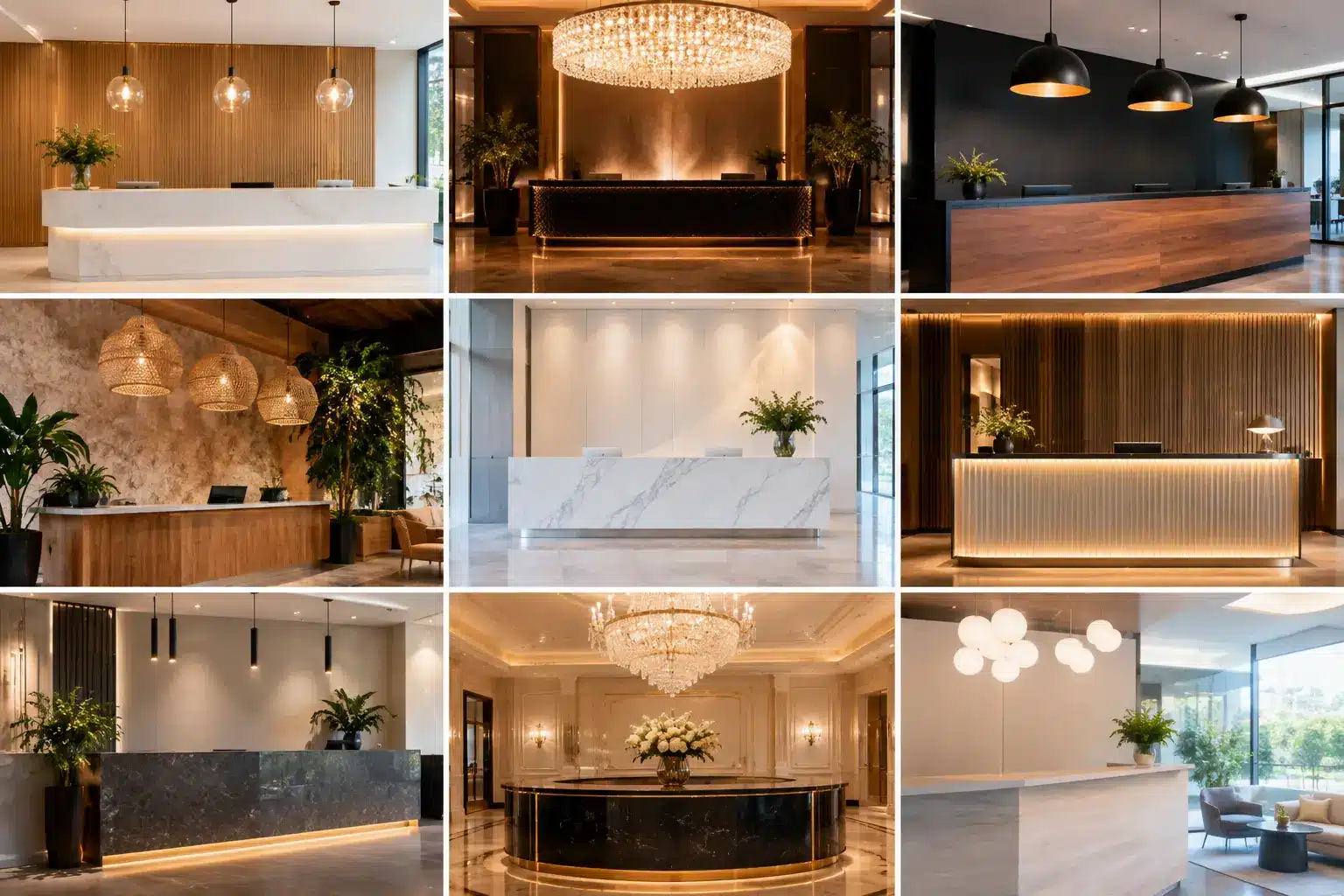
The first few seconds in a reception space do a great deal of work. Whether it is the hallway of a family home, a hotel lobby, salon, workplace or block of flats, the lighting tells people where to look, where to walk and how the space should feel. These reception lighting examples show how a considered mix of decorative and practical fittings can turn a pass-through area into a confident welcome.
What makes reception lighting work?
A reception needs more than one bright fitting in the middle of the ceiling. Good schemes combine ambient light for overall visibility, task light where people greet visitors or sign in, and accent light to bring out a desk, wall finish, artwork or architectural detail. This layered approach makes the room feel finished while avoiding harsh shadows around faces.
The right choice depends on ceiling height, available daylight, the scale of the desk and the personality of the property. A compact entrance may need a neat ceiling light and a pair of wall lights, while a double-height lobby can carry a statement pendant with ease. The shared principle is simple: light the people, the route and the feature that gives the reception its identity.
Reception lighting examples for a stronger arrival
1. A statement pendant above the desk
A feature pendant centred above a reception desk is one of the most effective ways to establish a focal point. In a hotel, clinic or design-led office, it immediately draws the eye to the point of welcome. Choose a fitting that has visual presence without dropping so low that it interrupts sightlines between staff and guests.
Glass pendants offer a lighter, refined look, particularly in smaller spaces where a solid shade could feel heavy. A black, brass or smoked-glass design brings more contrast and suits contemporary interiors with timber, stone or dark joinery. For a long desk, a linear pendant or three matching pendants create a more balanced composition than one oversized fitting.
2. Wall lights that soften a narrow entrance
Wall lights are an excellent answer to a narrow residential hallway or reception where ceiling space is limited. They wash light across the walls, visually broadening the area and making finishes feel more considered. Positioned either side of a mirror, artwork or brand sign, they create symmetry without demanding much floor space.
For homes, a pair of decorative wall lights can make the entrance feel as styled as the living room beyond it. In commercial settings, choose designs with frosted diffusers or shaded lamps to keep glare low for visitors waiting near the desk. Wall lighting also remains useful when the main ceiling fitting is switched off for a quieter evening atmosphere.
3. Downlights with a feature layer
Recessed downlights are often selected for receptions because they are tidy, practical and easy to position around circulation routes. Used alone, however, they can leave a space looking flat and overly functional. The more polished approach is to use dimmable downlights as the foundation, then add a pendant, wall lights or illuminated signage as the feature layer.
Avoid placing every downlight in a rigid grid without considering the room below. Instead, light the desk face, the doorway and the route through the space. Adjustable downlights work particularly well where a piece of art, textured wall or display shelf needs a focused beam. Warm white light generally creates the most welcoming result in a home, hospitality venue or client-facing reception.
4. LED strip beneath the reception desk
LED strip lighting gives a standard reception desk a floating, architectural finish. Install it beneath the kickboard or recess it into a shadow gap, and it casts a soft pool of light across the floor. This is especially effective with stone-effect tiles, polished concrete and timber flooring, where the light reveals texture without becoming the main event.
The finish matters as much as the LED itself. A continuous aluminium profile with a diffuser provides a clean, professional line and helps prevent visible dots of light. In a bespoke joinery project, tailored LED strip can follow a curved counter, stepped base or wall detail precisely. It is a small intervention with a high-end effect, provided the driver and wiring are planned before the desk is fitted.
5. Illuminated shelves and display niches
If your reception includes products, awards, decorative objects or literature, built-in shelf lighting can give these details purpose. Concealed LED tape at the front or back of each shelf adds depth and makes the display readable without filling the room with more ceiling fittings.
This is useful for salons, showrooms and hospitality settings, but it translates beautifully to a home entrance too. A softly illuminated alcove can showcase a favourite vase, framed photograph or sculptural object. Keep the light warm and restrained. The aim is to add atmosphere, not create a brightly lit display cabinet.
6. A large decorative ceiling fitting for a double-height space
High ceilings call for scale. In a double-height foyer, stairwell or hotel entrance, a clustered pendant, chandelier or sculptural multi-drop light gives the volume a clear centre of gravity. It can also make an otherwise empty vertical space feel intentional.
The trade-off is maintenance and proportion. A fitting that looks impressive from ground level may be difficult to clean or relamp, while one that is too small will disappear into the height. Measure carefully and think about how the fitting will be viewed from the entrance, landing and reception desk. Integrated LED designs reduce maintenance, while decorative lamp holders offer more flexibility if you want to change the mood later.
7. Mirror lighting that adds depth and practicality
A mirror is a hardworking feature in a residential hallway, a beauty business or a boutique reception. Light it correctly and it reflects both illumination and a sense of space. Wall lights on either side are often more flattering than a single fitting above, as they reduce strong shadows on the face.
For an entryway, a round mirror with two compact wall lights feels calm and balanced. In a commercial reception, a backlit mirror or an LED-framed design can bring a sharper contemporary edge. Be mindful of what the mirror reflects. Positioned well, it doubles daylight or showcases a beautiful pendant. Positioned poorly, it can magnify glare or visual clutter.
8. Track lighting for flexible, evolving spaces
Track lighting suits receptions that do more than one job. A creative studio, gallery, retail counter or multi-use office can use adjustable spotlights to illuminate a desk today and reposition them for a product display, seasonal installation or new artwork tomorrow. It brings a purposeful, slightly architectural look that works well with exposed ceilings and modern finishes.
Use a warm beam angle for softer general lighting, then aim narrower heads at focal points. Too many bright spots pointed directly down can make visitors feel as though they are under inspection, so balance the track with wall wash or decorative lighting. Black track blends confidently into dark ceilings, while white track tends to disappear against a pale ceiling.
9. Exterior-to-interior lighting that feels connected
The best arrival experience starts before someone reaches the front door. A lit pathway, porch wall lights or a neat downlight at the entrance should lead naturally into the reception or hallway beyond. Repeating a finish, such as black metal or brushed brass, creates a subtle thread between outside and inside.
This matters particularly during darker Irish evenings, when the move from driveway or pavement to front door needs to feel safe as well as stylish. Choose exterior-rated fittings for exposed areas and make sure the entrance number and threshold are clearly visible. Inside, a welcoming glow rather than a sudden blast of cool white light makes the transition far more comfortable.
Practical choices that protect the look
Dimming is one of the most worthwhile additions to reception lighting. It allows a bright, clear setting for working hours and a softer scene for evening appointments, guests or relaxed family arrivals. Before choosing fittings, check that the lamps or integrated LEDs are compatible with the intended dimmer.
Colour temperature also shapes the result. Around 2700K gives a warm, residential feel, while 3000K is often a strong choice for contemporary commercial receptions because it remains welcoming but looks crisp around clean finishes. Cooler light can suit highly practical areas, but it is rarely the first choice where atmosphere matters.
Finally, think about glare from the viewpoint of the person arriving. A beautiful pendant with an exposed bulb may look excellent from behind the desk but uncomfortable when seen directly from the doorway. Diffused shades, frosted lamps and carefully angled spotlights make a meaningful difference.
A memorable reception does not have to rely on one dramatic fitting. Start with a clear route, add the light people need, then choose one detail that makes the space feel unmistakably yours. For custom counters, shelving and feature walls, Lux Lighting can help turn that final detail into a scheme with real presence.