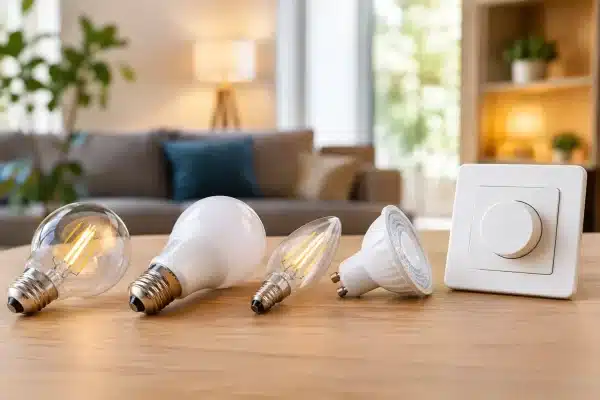
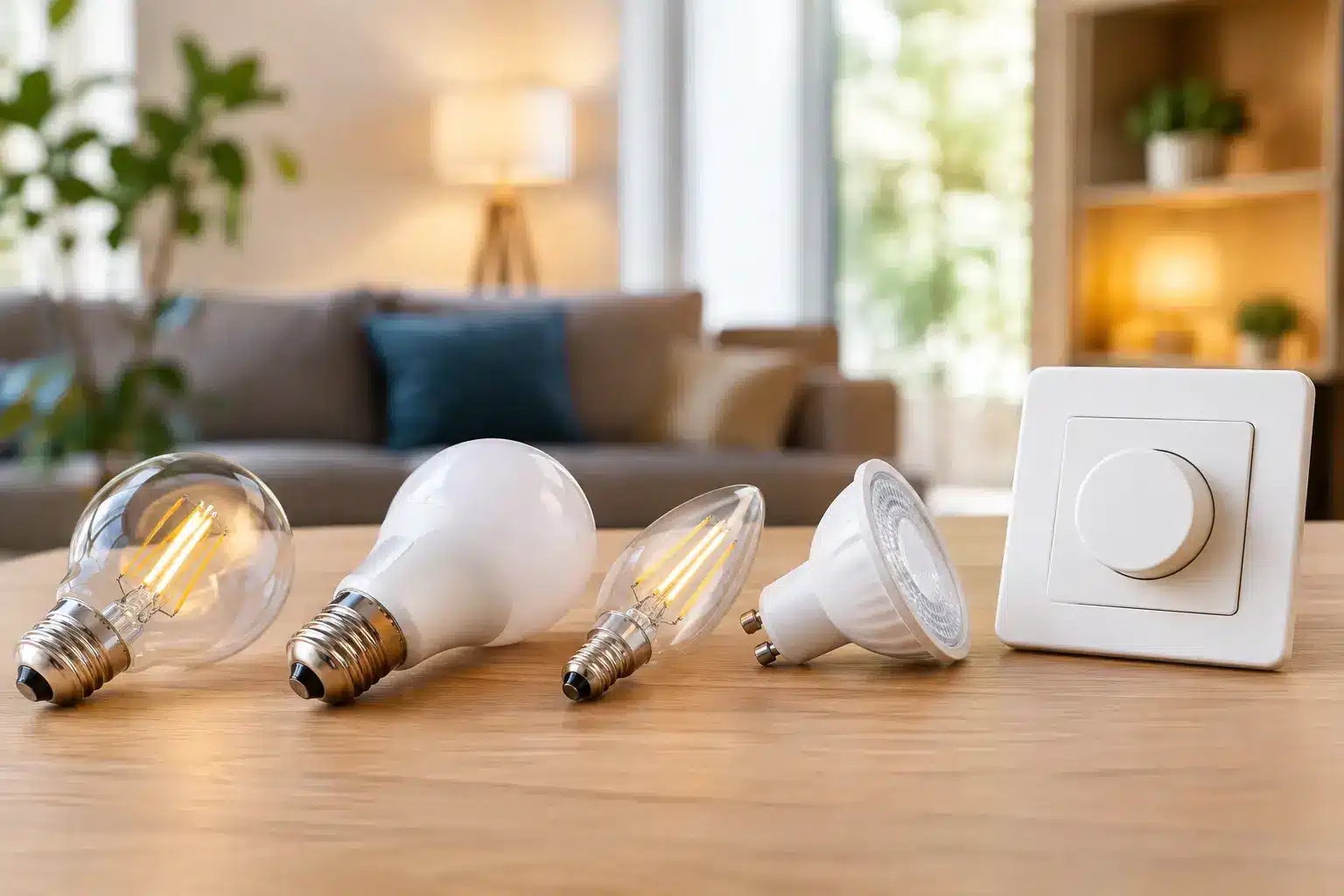
A pendant that feels bright enough for breakfast can look harsh over a late dinner. That is where dimming earns its place. Knowing how to choose dimmable bulbs means you can give one fitting more than one purpose: clear task lighting when needed, then softer, more atmospheric light when the room calls for it. The key is not simply buying a bulb marked “dimmable”. The bulb, fitting and wall control need to work as a considered combination.
Start with the fitting, not the bulb
Before looking at wattage or bulb shape, check what the fitting takes. The lamp holder determines the cap type, while the shade, glass and position of the fitting influence how much light you need and how the bulb will look when switched off.
The most common domestic cap types are E27 screw, E14 small screw, B22 bayonet and GU10 spotlight. A bulb must match the holder exactly. For enclosed shades, globe pendants and lantern-style fittings, also check the maximum permitted wattage and whether the bulb will physically fit inside. Decorative filament LEDs can make a feature of an open pendant, but a frosted bulb is often the better choice where the light source sits at eye level.
Consider the fitting’s job too. A single central ceiling light in a kitchen needs a different output to bedside lamps or wall lights in a snug. Dimming improves flexibility, but it cannot compensate for a scheme that starts out underlit.
Check that the bulb is genuinely dimmable
This sounds obvious, yet it is the most common source of frustration. A standard non-dimmable LED should never be used on a dimmer circuit. It may flicker, buzz, fail early or refuse to turn fully off. Look for clear dimmable wording on the bulb packaging or product specification.
Most modern dimmable LEDs are a strong choice because they use far less energy than older halogen lamps and produce much less heat. But “dimmable” does not mean every LED will behave perfectly with every dimmer switch. The electronics inside LED bulbs vary between ranges, and older dimmers were designed around the much higher loads of incandescent and halogen lamps.
For a polished result, choose bulbs from the same range when several lamps are controlled by one switch. Mixing different brands, wattages or lamp styles can lead to uneven fading, especially at low levels.
Match the bulb to the dimmer switch
A compatible dimmer is just as important as a compatible bulb. LED-friendly dimmers are typically labelled for LED use and often use trailing-edge technology. They are generally the preferred option for dimmable LED lamps because they deliver smoother control, quieter operation and better low-level performance.
Older leading-edge dimmers can still work with some dimmable LEDs, but compatibility depends on the specific bulb and switch. If a circuit has been converted from halogen to LED, the existing dimmer may be the part that needs upgrading rather than the bulbs themselves.
Pay attention to the dimmer’s minimum and maximum load. With LEDs, the total wattage on a circuit can be surprisingly low. For example, six 5W bulbs use only 30W together. If that sits below the dimmer’s minimum requirement, you may see flickering, delayed start-up or a limited dimming range. The switch specification should state its LED load range.
Many quality dimmers have an adjustable minimum brightness setting. This is useful when a bulb begins to flicker at its lowest point. A qualified electrician can set the lower level so the lights dim smoothly without cutting out.
Choose brightness in lumens, not old-style wattage
Wattage tells you how much energy a bulb uses. Lumens tell you how much light it produces. When comparing efficient LEDs, lumens are the figure that matters.
For ambient lighting, a 400 to 600-lumen bulb is often enough in a table lamp, wall light or small pendant. Around 800 lumens suits many general-purpose ceiling fittings, roughly comparable to a traditional 60W incandescent bulb. Larger rooms, high ceilings and dark finishes may need more output, spread across multiple fittings rather than forced from one overpowering central lamp.
Dimming gives you permission to specify a little more light where a room has changing demands. In a kitchen, brighter bulbs can support food preparation and cleaning, then be reduced for a relaxed evening feel. In a living room, however, it is usually more effective to layer moderate-output ceiling, wall and table lighting than to rely on one very bright pendant turned down all the time.
Get the colour temperature right
The warmth of the light changes a room as much as its brightness. Colour temperature is measured in kelvins (K), and it deserves as much attention as the fitting finish or shade material.
Warm white, around 2700K, creates the familiar golden tone that suits living rooms, bedrooms, dining spaces and decorative lamps. It works especially well with timber, warm neutrals, brass and layered soft furnishings. For a slightly cleaner but still welcoming look, 3000K is a popular option in kitchens, halls and contemporary open-plan spaces.
Cooler white light, commonly 4000K, is more practical and crisp. It can suit utility rooms, garages and task-focused commercial areas, but it often feels too clinical for a relaxed home setting. A beautifully dimmed bulb cannot create a cosy atmosphere if its colour temperature is overly cool.
Where possible, keep colour temperature consistent within sightlines. A warm living area flowing into a stark white kitchen can make both spaces feel less intentional. Contrast can work, but it should be a design decision rather than an accidental mix of bulbs.
Consider the bulb’s appearance and beam
Not every dimmable bulb is designed to be seen. Clear filament LEDs bring character to exposed pendants, chandelier arms and statement wall lights. They create sparkle and a decorative glow, though their clear glass can produce more visible glare in bare fittings.
Frosted bulbs soften the source and are often more comfortable in open ceiling lights, bathroom fittings and lamps where the bulb may be directly visible. For directional lighting, a dimmable GU10 spotlight lets you place light exactly where it is useful: across kitchen worktops, onto artwork or down a hallway. Look at beam angle as well as brightness. A narrow beam creates drama and focus; a wider beam gives more even coverage.
Bulb shape matters visually. Globes make an impact in open pendants, candle bulbs suit chandeliers and wall lights, while classic pear-shaped lamps are versatile choices for everyday fittings. In a decorative fitting, the wrong shape can undermine the silhouette even if the technical specification is correct.
Think room by room, and layer the light
A well-dimmed home is rarely lit by one source per room. In the living room, a dimmable central pendant can establish the base layer, while table lamps and wall lights create warmth around seating. Put these on separate controls where possible, so the room can move easily from family time to film night.
In bedrooms, dimmable bedside lights are particularly valuable. They allow enough light for reading without flooding the room with brightness before sleep. Choose warm bulbs and avoid exposed lamps that create glare when you are lying down.
Kitchens need the most practical thinking. Dimmer-controlled ceiling lights can adjust the general mood, but task lighting over worktops should still be planned properly. Under-cabinet LED lighting, pendants above an island and ceiling spots do different jobs. Dimming the whole room is useful, but it should not leave preparation areas in shadow.
For bathrooms, only use bulbs and fittings appropriate for the zone and the fitting’s IP rating. Dimming can create a spa-like effect around a bath, but safety and compliant installation always come first.
Do you need smart dimmable bulbs?
Smart bulbs offer dimming from an app, remote control or voice assistant, often without replacing a standard wall switch with a traditional dimmer. They can be ideal for lamps, rented homes or spaces where you want scene-setting control without rewiring.
There is one important rule: smart bulbs normally need constant power. If they are fitted to a conventional dimmer circuit, leave that dimmer at full power or replace it with a compatible control. Using both systems to dim the same bulb can cause unreliable performance.
Smart lighting is excellent for creating preset scenes – bright morning light, relaxed dining, late-night hallway guidance – but a quality conventional dimmer remains a simple, tactile and dependable choice for many rooms.
Avoid the small mistakes that cause flicker
If dimmable LEDs buzz, flash or fail to dim low enough, do not assume the bulbs are poor quality. Check whether the switch is LED-compatible, whether the total load sits within its range and whether all bulbs on the circuit are dimmable. Loose connections and incompatible transformers can also be an issue, particularly with older low-voltage fittings.
For multi-bulb pendants and larger projects, it is worth planning the components together rather than selecting each one separately. The finish, bulb shape, light level and control method should all support the same atmosphere.
The best dimmable bulb is the one that disappears into the experience of the room: bright and practical when life is busy, then soft enough to make a space feel settled, considered and unmistakably yours.