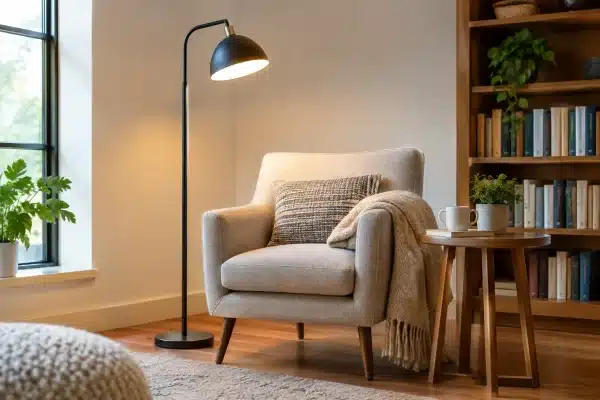
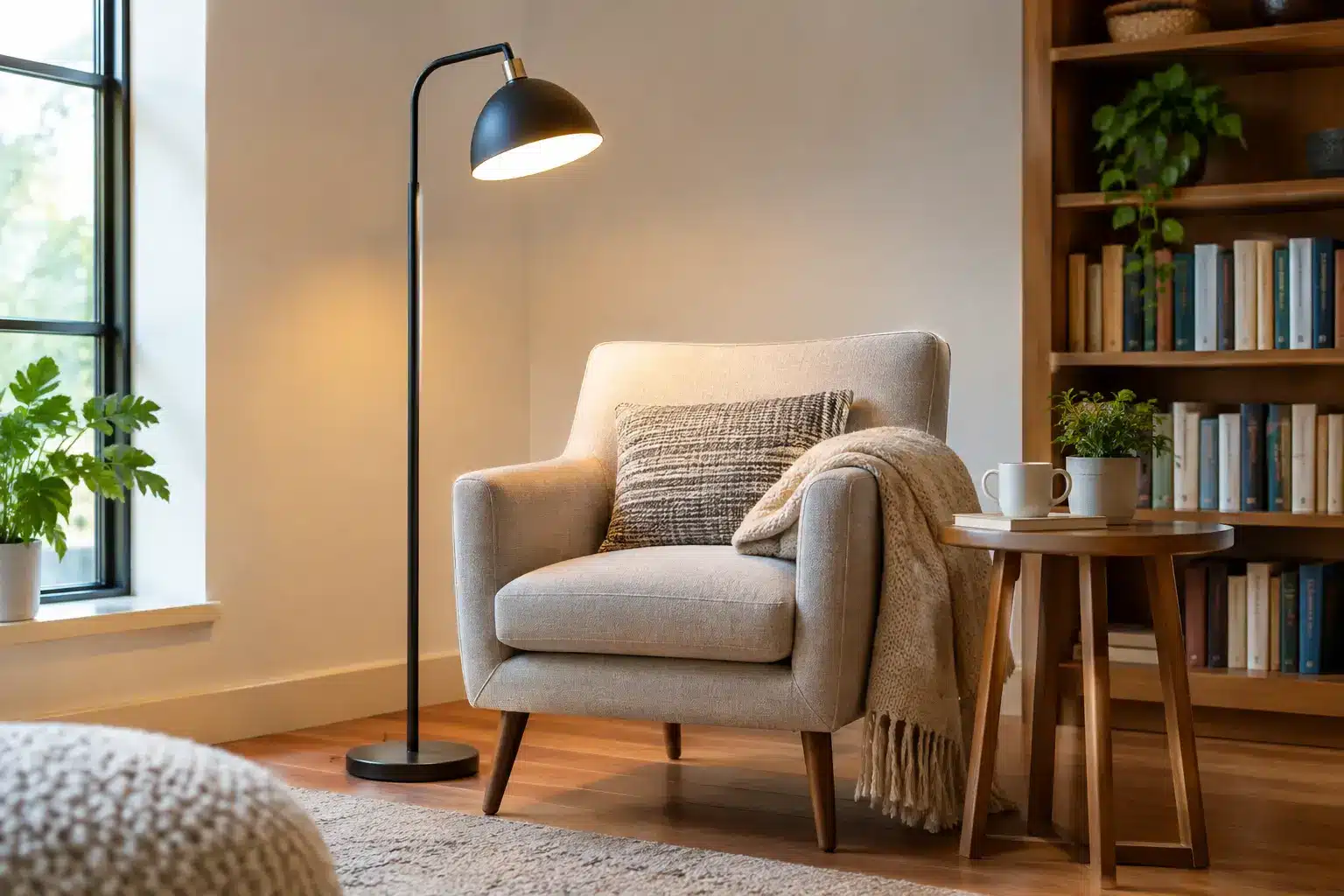
A beautiful armchair is only half a reading corner. When the light falls behind your shoulder, glares across the page or leaves you squinting by dusk, even the most inviting seat loses its appeal. The right floor lamps for reading give a favourite corner purpose: clear, comfortable illumination for the page, with a design that still earns its place in the room.
Unlike general ambient lighting, a reading lamp has a very specific job. It needs to direct useful light exactly where it is wanted, minimise shadows and feel comfortable during a long chapter rather than simply looking impressive from across the room. That practical focus does not mean compromising on style. A slim black task lamp, a warm brass uplighter or a sculptural arc design can each shape the character of a living room, bedroom or study.
What makes a floor lamp good for reading?
The best reading lamps balance direction, height, brightness and control. A shade that focuses light downwards is often more useful beside an armchair than an open decorative shade that disperses light around the room. Adjustable heads are especially valuable because they allow you to aim the beam at a book, magazine, crossword or e-reader rather than illuminating the back of the chair.
Position matters just as much as the fitting itself. For most people, light works best when it comes from slightly behind and to one side of the seated position. This helps prevent your head and hands casting a shadow over the page. A lamp placed too far away may create a patch of weak light, while one sitting very close at eye level can feel harsh.
Height is another detail worth getting right. A taller floor lamp can cast light over the shoulder of a high-backed chair, while a more compact adjustable design may suit a low sofa or occasional chair. Before choosing, consider where the bulb or light source will sit when you are seated. It should light your reading material, not shine directly into your eyes.
Choose a floor lamp to suit the way you read
There is no single best shape for every room. The right choice depends on your furniture layout, the type of reading you enjoy and whether the lamp also needs to contribute to the room’s wider atmosphere.
Adjustable task lamps
An adjustable task lamp is often the most practical option for dedicated reading. Look for an angled arm, a swivelling head or a flexible neck that can bring light closer without taking up table space. These designs suit readers who move between a paperback, newspaper and tablet, as the direction can be changed in seconds.
They are particularly effective beside a recliner, in a home office reading nook or alongside a bed where a wall-mounted fitting is not an option. In a modern scheme, choose clean lines in matt black, satin nickel or soft white. Brass or antique bronze finishes bring more warmth to classic interiors and darker, moodier living spaces.
Uplighter floor lamps with a reading arm
For rooms that need more than one layer of light, an uplighter with an integrated reading arm is a smart solution. The upper shade reflects a gentle wash of light on to the ceiling, helping the room feel brighter overall, while the smaller arm provides the focused beam needed for a book.
This style works well in a family living room where one person wants to read and others are watching television or relaxing nearby. The trade-off is visual simplicity: these fittings can be more functional in appearance than a standalone statement lamp. Choose a well-proportioned design and a finish that relates to your furniture hardware or other light fittings, and it can still feel considered rather than purely practical.
Arc floor lamps
Arc lamps bring light over the arm of a sofa or chair without requiring a side table. Their long curved stem creates a strong silhouette and makes them an excellent choice for spacious living rooms, open-plan homes and corners where the socket is set back from the seating.
For reading, check that the shade can be directed down towards the page and that the reach is sufficient for your furniture. A fixed shade that hangs too high may create ambience rather than usable task light. Arc lamps also need a stable, weighty base, so they are best positioned where the footprint will not interrupt a walkway.
Slim LED reading lights
Integrated LED floor lamps have a refined, architectural feel and are ideal when you prefer a discreet fitting. Their narrow profiles work beautifully in compact rooms, beside occasional chairs or in bedrooms where visual clutter quickly becomes noticeable. Many include touch controls or dimming, which makes it easier to move from bright reading light to a softer evening glow.
The main consideration is the light source itself. With an integrated fitting, the LED is built in rather than replaced like a standard bulb. Quality designs are made for long-term use, but choosing the right colour temperature and dimming function at the outset becomes more important.
Brightness and bulb colour: the details your eyes notice
A reading lamp should be bright enough to make print clear without making the whole corner feel clinical. As a guide, a reading light around 400 to 800 lumens is suitable for many homes, though your ideal level will vary with your age, the darkness of the room and the opacity of the shade. A dark shade absorbs more light, while a pale or open shade allows more of it through.
For evening reading, warm white light usually feels most at home in a living room or bedroom. Around 2700K gives a relaxed, golden tone that complements timber, textured fabrics and warm metallic finishes. If you read detailed text, work through paperwork or use the lamp in a study, a slightly cooler 3000K can offer a cleaner look without feeling stark.
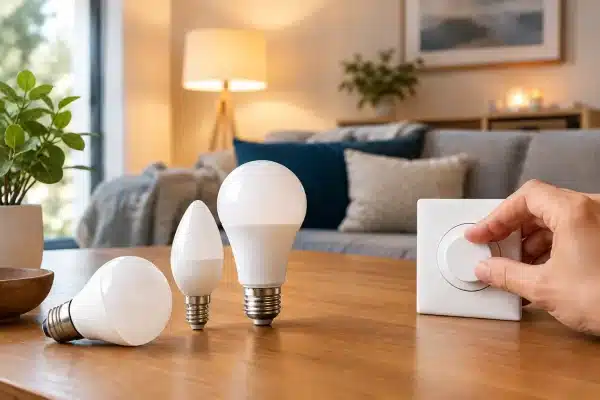
Dimming gives you the most flexibility. Start brighter when you need focus, then lower the level as the evening settles in. A dimmable bulb only works properly with a compatible dimmer, so it is worth checking both elements before buying. For integrated LED lamps, look for built-in dimming or a clearly stated dimming method.
Be mindful of exposed bulbs. They can look striking in a decorative lamp, but a clear filament bulb is rarely the most comfortable choice when it sits within your direct line of sight. An opal bulb or a shaded fitting softens the source and reduces glare, which is far more pleasant during an unhurried reading session.
Styling reading lamps into the room
A floor lamp should make a reading corner feel intentional, not like an afterthought. Begin with the chair. If it has rounded, generous lines, a slender metal lamp creates contrast; if the chair is tailored and angular, a curved shade or gentle arc can soften the arrangement. Match finishes loosely rather than rigidly. A brass lamp can sit beautifully with black-framed art, oak furniture and neutral upholstery without every metal detail needing to match.
Scale is key. A large drum shade can look confident beside a deep lounge chair, but it may overwhelm a delicate accent chair. Conversely, a very slim lamp can disappear next to an oversized sofa unless its finish or form offers enough definition. Use the lamp to build height in a low corner, especially where a chair, footstool and side table all sit below eye level.
A small side table remains useful even when the lamp is freestanding. It gives you somewhere for a cup of tea, reading glasses and the book you are not quite ready to put down. Add one tactile element, such as a wool throw or linen cushion, and the area becomes a genuine destination within the room rather than an unused patch beside the window.
Practical checks before you choose
Measure from the socket to the intended position and think about the cable route before falling for a design. A trailing lead across a walkway is inconvenient and can spoil an otherwise polished room. Consider the base too: a heavy marble-style base gives stability, while a smaller circular base may be easier to place beside furniture with limited clearance.
If the lamp will sit close to children, pets or a frequently used sofa, prioritise a stable base and a shade that does not protrude into the room. Foot switches are convenient when your hands are full, while in-line switches may be better if you prefer control closer to the chair. Smart bulbs can add app or voice control to compatible fittings, although a straightforward physical switch is often the easiest option for a dedicated reading lamp.
At Lux Lighting, the strongest choices are the ones that solve the practical problem while adding a finish, silhouette or glow that makes the whole room feel more complete. Choose a floor lamp that invites you to sit down, switch off and read one more page.