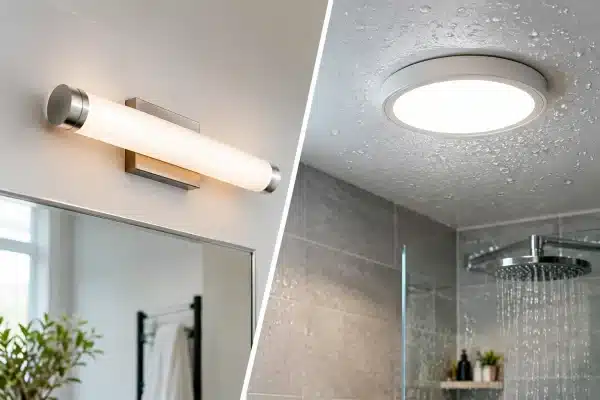
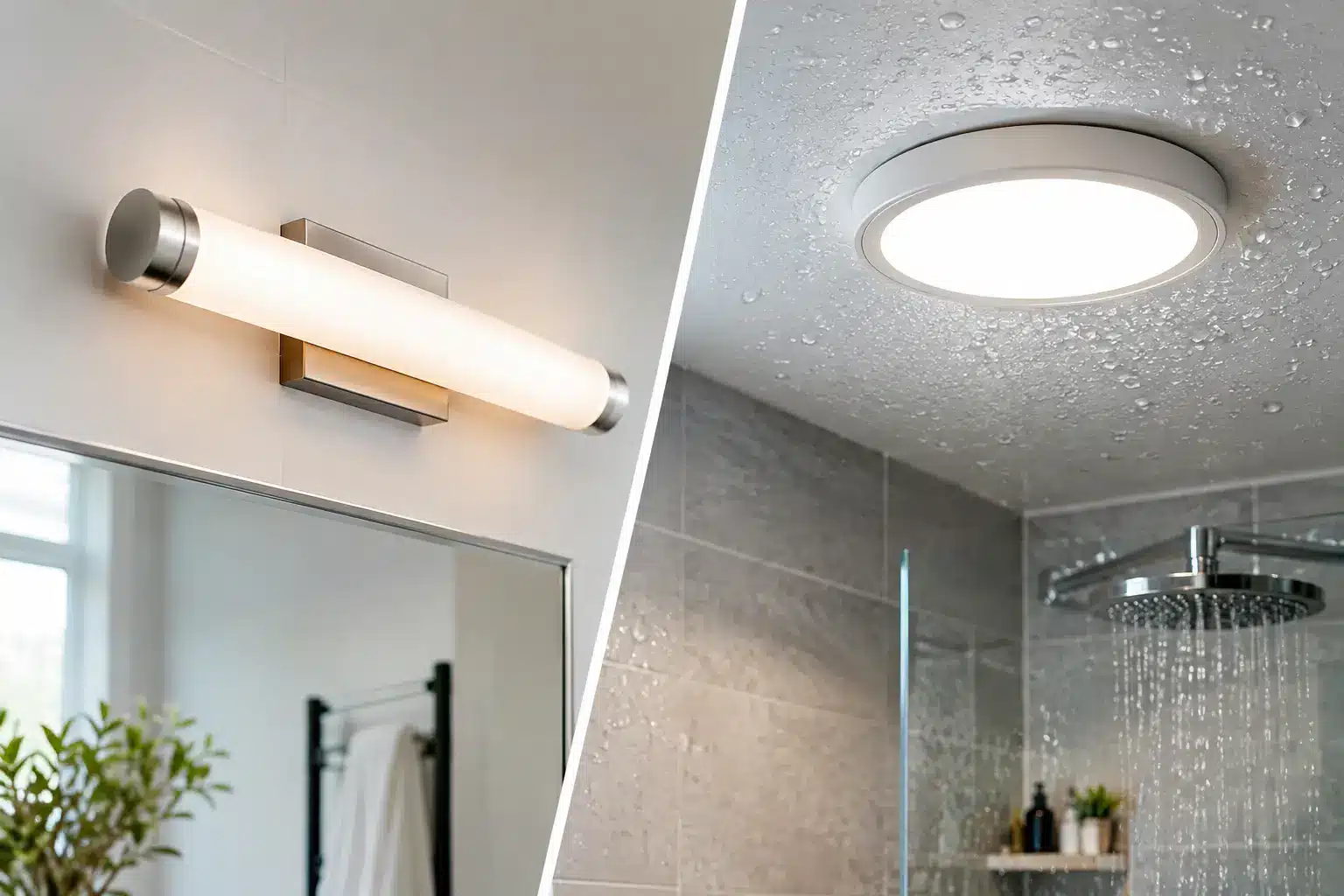
A beautiful bathroom can be transformed by a soft-glow mirror, sculptural wall lights or a clean line of recessed downlights. But before choosing finishes and colour temperature, there is one detail that cannot be treated as an afterthought: the fitting’s IP rating. The choice between IP44 versus IP65 bathroom lighting is not simply about buying the higher number. It is about placing the right level of protection exactly where water is most likely to reach it.
The good news is that a safe bathroom scheme can still feel considered and luxurious. Once you understand the bathroom zones and what each IP rating means, selecting lighting becomes far more straightforward.
What do IP44 and IP65 mean?
IP stands for Ingress Protection. The two numbers that follow tell you how well a fitting is protected from solid objects and moisture.
With IP44, the first 4 means the fitting is protected against solid objects larger than 1mm, while the second 4 means it is protected from water splashing from any direction. This is a popular rating for many bathroom wall lights, mirror lights and ceiling fittings positioned away from direct water exposure.
With IP65, the first 6 means the fitting is dust-tight. The second 5 means it is protected against water jets from any direction. It offers a more sealed construction and is a strong choice for areas exposed to heavier splashing, as well as for some outdoor settings.
For a bathroom, the second digit is normally the deciding factor. Bathrooms are humid, but the real question is whether a fitting could receive direct splashes or a concentrated flow of water. An IP65 fitting provides greater water resistance than IP44, but it is not automatically the correct choice in every location.
IP44 versus IP65 bathroom zones
Bathroom electrical zones help determine the minimum protection a fitting needs. They are based on the position of the bath, shower and nearby areas, rather than on how large or small the room happens to be.
Zone 0: inside the bath or shower tray
Zone 0 is the area inside the bath or shower basin itself. Any light installed here must be suitable for immersion, typically with a minimum IPX7 water-protection rating, and it must be designed for this highly specific use.
Neither IP44 nor IP65 is enough for Zone 0. This is an easy point to miss: IP65 protects against water jets, not immersion. If a fitting is likely to be submerged, it needs the correct immersion rating rather than simply a higher-looking IP number.
Zone 1: directly above the bath or shower
Zone 1 sits directly above the bath or shower up to 2.25 metres from the finished floor level. It is the area most likely to receive steam, rising moisture and occasional direct splashes.
A fitting in Zone 1 generally needs at least IPX4 protection against splashing water. That means an IP44 fitting can be suitable where there is no use of water jets for cleaning. IP65 also meets and exceeds that water-protection requirement, making it an appealing choice for recessed shower downlights or a fitting placed very close to the shower area.
The most appropriate option depends on the product’s intended installation location and the overall bathroom design. Always check the manufacturer’s stated zoning suitability, not just the headline IP rating.
Zone 2: the area surrounding the bath or shower
Zone 2 extends 0.6 metres horizontally beyond the bath or shower edge, as well as the area around a wash basin where splashing is likely. This is where decorative choices start to open up, but moisture protection still matters.
IP44 is often the practical and stylish answer in Zone 2. It makes it possible to introduce bathroom-rated wall lights, illuminated mirrors and compact ceiling fittings without over-specifying every element of the scheme. IP65 can still be used here, particularly if you prefer a fully sealed downlight or expect regular heavy splashing, but it is not always necessary.
Outside the zones
Outside the defined bathroom zones, a light may not require a specific bathroom IP rating under the zoning rules. However, that does not mean any decorative fitting is automatically a wise choice. A poorly ventilated bathroom can remain humid long after a shower, and a fitting above a basin may still encounter moisture over time.
An IP44-rated light is often a sensible investment beyond the formal zones, especially for mirror lighting and fittings near the vanity. It gives greater peace of mind while keeping your choices broad enough to create a more layered, design-led room.
When IP44 is the right choice
IP44 is ideal for many everyday bathroom applications. Think of an illuminated mirror above a basin, a pair of wall lights framing a vanity, or a central ceiling light positioned beyond the immediate shower area. It offers splash resistance without limiting you to the more enclosed look often associated with high-IP technical fittings.
This matters in a bathroom where the lighting needs to earn its place visually. A matte black wall light can bring structure to pale tiles. Brushed brass mirror lights can add warmth to a contemporary ensuite. An IP44 fitting lets you make these decorative decisions while maintaining suitable protection in splash-prone areas.
It is also worth remembering that IP44 does not describe build quality, finish durability or light output. Choose a fitting with a finish that complements your taps and accessories, a colour temperature that flatters skin tones, and enough brightness for practical tasks such as shaving, skincare and applying make-up.
When IP65 earns its place
IP65 is particularly useful for recessed lighting in and around shower areas. Its sealed design creates a neat, minimal finish in the ceiling while offering protection against stronger exposure to water. For a walk-in shower, an IP65 downlight can provide focused, practical illumination without interrupting a calm, spa-inspired look.
It is also a smart option where a bathroom sees heavy use. Family bathrooms, busy guest bathrooms and spaces with limited ventilation can all benefit from fittings with a more sealed construction. That said, IP65 should not be used as a substitute for effective extraction. Good ventilation protects your lighting, mirrors, paintwork and finishes from persistent condensation.
The trade-off is aesthetic flexibility. IP65 downlights are available in attractive finishes, but decorative IP65 wall and ceiling fittings are less common than IP44 options. A well-planned scheme often uses both: IP65 within the shower zone, then IP44 mirror or wall lighting to bring warmth and character elsewhere.
Build a layered bathroom lighting scheme
A single bright ceiling fitting can make a bathroom functional, but it rarely makes it feel special. The most successful schemes combine ambient, task and accent light, while matching every fitting to its location.
Start with ceiling lighting for overall brightness. In a shower area, this may mean IP65 recessed downlights. Around the rest of the ceiling, IP44 downlights or a bathroom-rated flush fitting can provide a softer, more balanced spread of light.
Then consider task lighting at the mirror. Integrated LED mirrors offer a clean, contemporary solution, while wall lights on either side of the mirror can reduce the shadows created by overhead lighting. For a more relaxed evening atmosphere, add a dimmable circuit or separate switching so the mirror lighting and main ceiling lights do not always need to operate together.
If you are renovating, plan the lighting positions before finalising tile layouts and mirror size. This avoids a common compromise: a beautiful mirror fitted off-centre because the electrical point was not considered early enough. For bespoke LED strip lighting in niches, under floating vanity units or along architectural ledges, use a system specified for the location, with the driver placed where it remains accessible and protected.
Do not rely on the rating alone
An IP rating is essential, but it is only one part of a safe installation. Bathroom lighting should be installed in line with current electrical requirements by a qualified electrician, particularly when circuits, transformers, dimmers or new wiring are involved. The fitting must also be suitable for the voltage, bathroom zone and installation method.
Check whether the product is rated for use in the exact zone you have in mind. Consider the ceiling height, shower screen position and whether a handheld shower could direct water towards the fitting. A large rainfall shower beneath a low ceiling needs a different level of thought from a compact cloakroom basin.
Also look for fittings that allow practical maintenance. Integrated LED lights can be slim and elegant, but consider their warranty and expected service life. With replaceable bulbs, confirm that the bulb itself is appropriate for enclosed fittings and that you can access it safely once installed.
Choose protection without losing the style
For most bathrooms, the answer is not IP44 or IP65 throughout. Use IP65 where direct water exposure calls for it, especially in the shower area. Use IP44 where splash protection is needed but decorative freedom matters, such as around mirrors, vanities and the wider bathroom ceiling.
That approach gives you a scheme that feels intentional rather than overly clinical: secure where it needs to be, beautifully lit where you see it most, and ready to make every morning and evening routine feel more polished.