A kitchen should not feel like a waiting room at breakfast, then a worktop workshop after dark. The future of smart home lighting is less about speaking to a bulb and more about giving each room the right light, at the right level, without making everyday life feel complicated.
For homeowners planning a renovation or simply improving a few key spaces, that is a meaningful shift. Smart lighting is moving beyond coloured party scenes and novelty controls. It is becoming a design tool: one that can make a compact hallway feel more considered, help a kitchen work harder and bring a garden to life after sunset.
The future of smart home lighting is layered
The strongest lighting schemes have always used layers. General lighting lets you move around safely, task lighting supports cooking, reading or getting ready, and accent lighting adds depth. Smart control is now making those layers more useful because they can respond independently rather than switching on at one fixed brightness.
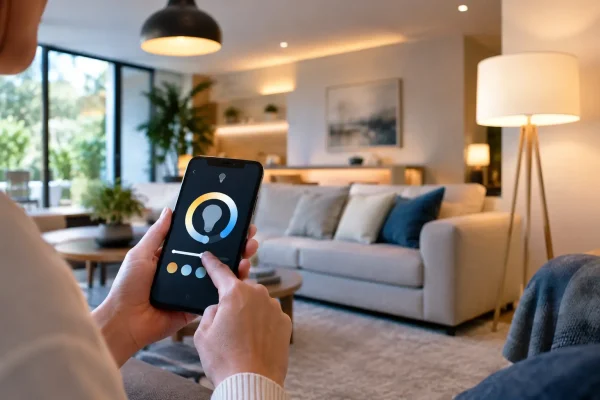
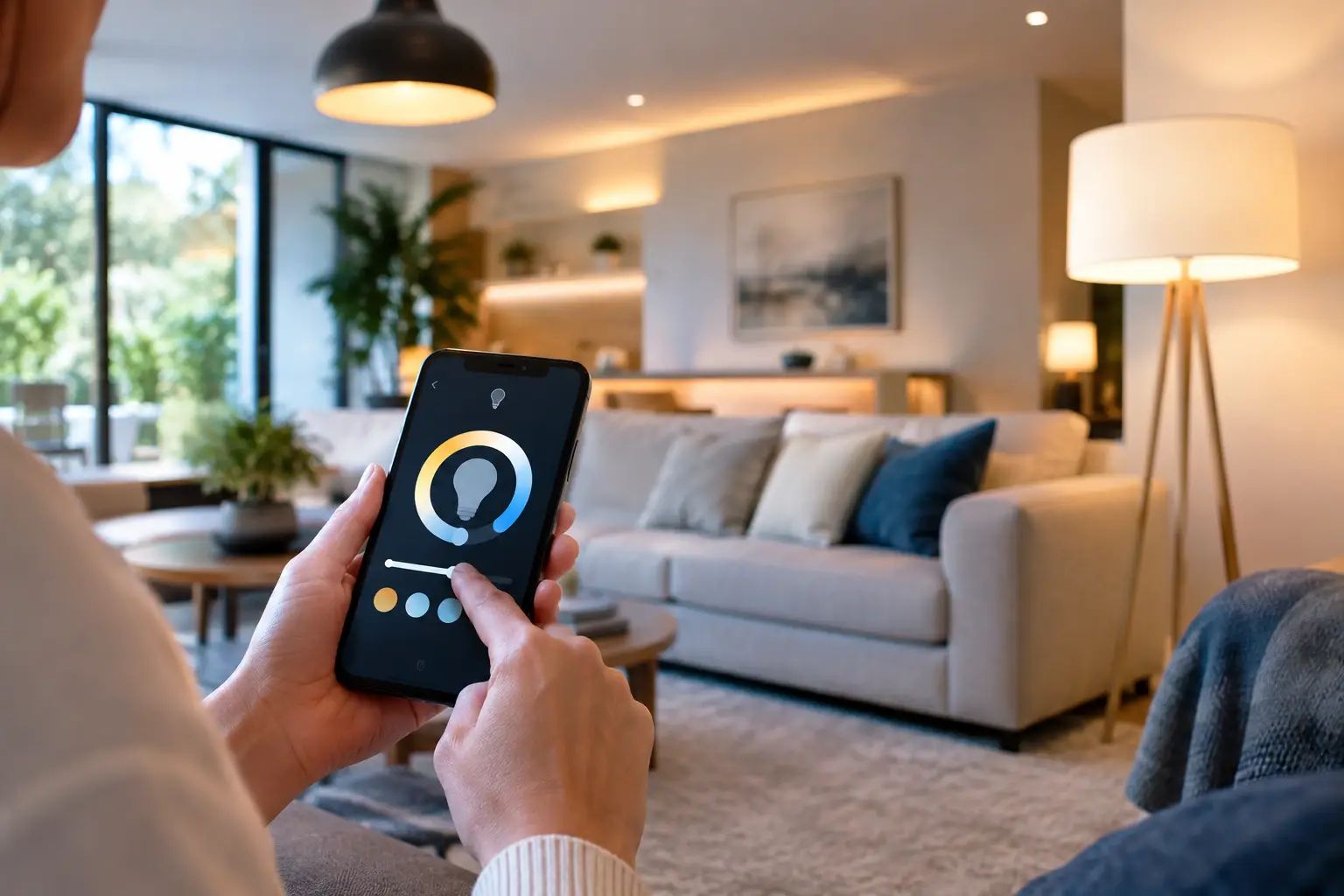
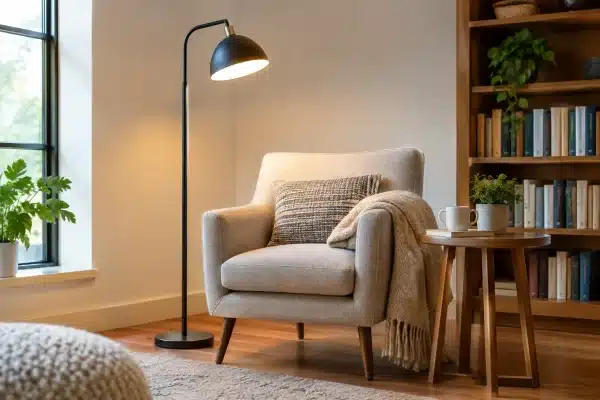
In a living room, for example, ceiling lighting can provide a welcoming base level while a floor lamp creates a reading corner and LED strip lighting gives a media wall or joinery a soft architectural glow. One setting can bring all three together for guests. Another can leave only the warm, low-level layers on for a quiet evening.
This is where smart lighting earns its place in a design-led home. The fitting still matters. A beautiful pendant, wall light or table lamp gives the room its character; smart controls make that character more adaptable. The aim is not to fill every ceiling with downlights, but to make each chosen fitting work with greater intention.
Better dimming, better colour, better comfort
Expect the quality of light to matter more than the number of features. Earlier smart bulbs could offer colour but sometimes produced weak whites, uneven dimming or an obvious delay when controlled. Newer systems are increasingly judged on how naturally they dim, how accurately they render colours and how reliably they behave day after day.
Tunable white lighting is particularly useful. Cooler, clearer light can support practical morning routines, food preparation and focused tasks. In the evening, a warmer tone makes a room feel calmer and more flattering. It does not need to imitate daylight minute by minute to be worthwhile. Even a simple choice between a crisp working scene and a warm wind-down scene can transform how a space feels.
For bathrooms, dressing areas and kitchens, prioritise high-quality white light and good colour rendering before chasing decorative colours. Colour-changing lamps are excellent for a child’s bedroom, a home bar or occasional entertaining, but warm white ambience is likely to be used far more often.
Controls will become less visible
The best smart home is not one that asks everyone to use an app for the simplest task. It is one where the lighting feels intuitive whether someone uses a wall switch, a dimmer, a voice assistant or an automated setting.
That means the future belongs to flexible control rather than app-only systems. A physical switch should still work for guests, children and anyone who just wants light immediately. Wireless switches and scene keypads can add control without chasing cables through a finished wall, while smart dimmers can retain the familiar feel of traditional lighting control.
Automation will also become quieter and more useful. Motion and presence sensors can bring low-level light into a hallway, cloakroom or utility room, then switch it off when it is no longer needed. Timers can make exterior lighting feel welcoming in winter. In bedrooms, a gradual low-level wake-up setting may be gentler than a main light turning on at full brightness.
The important distinction is between helpful automation and irritating automation. A sensor that turns the bathroom lights off while someone is in the bath is not clever. Placement, timing and the ability to override a setting are just as important as the technology itself.
Connected systems should become easier to choose
For years, smart lighting has asked shoppers to think about hubs, wireless protocols, compatibility and competing apps before they can even choose a pendant or lamp. That complexity has held some projects back.
Industry standards are beginning to make it easier for devices from different brands to work together, although compatibility should still be checked carefully before buying. A single ecosystem can be the simplest route for a smaller upgrade. A more considered system, with compatible switches, sensors, lamps and LED drivers, may be a better investment for a full renovation or a commercial project.
There is a trade-off. Smart bulbs are quick to fit and ideal for portable lamps or individual decorative fittings, especially where rewiring is not practical. But where several downlights or a full lighting circuit need to work together, a smart switch, dimmer or professionally specified control system often gives a cleaner result. It keeps the fittings consistent and avoids the problem of someone switching off power at the wall, leaving the smart bulb unreachable.
For bespoke cabinetry, alcoves, stair details and media walls, smart LED tape is likely to become even more popular. It can be cut and specified around the architecture of a space, rather than treated as an afterthought. The finish depends on the details: profile, diffuser, driver location, access for maintenance and the quality of the LED tape all affect the final effect.
Energy savings are becoming part of the design brief
LED lighting already uses far less energy than older lamp technologies, but smart controls can reduce wasted hours as well. Dimming, schedules, occupancy sensing and daylight-responsive settings help ensure a light is used when it adds value, not simply because it was left on.
That is especially relevant in kitchens, open-plan living spaces and commercial settings, where multiple zones are often lit for longer than necessary. In a hospitality venue, separate scenes can support breakfast service, daytime trade, dinner and late-evening atmosphere without changing the entire installation. At home, it may be as straightforward as keeping the island pendants on while the rest of the kitchen drops to a softer level.
Energy saving should not mean a darker or less welcoming home. Well-planned lighting uses light where it is needed, then relies on focused task lighting and gentle accents to preserve atmosphere. A dimmed lamp beside a sofa can often create a better evening setting than every downlight switched on.
Privacy and reliability will matter more
As lighting becomes connected, it is sensible to consider who can access the system and what happens when broadband drops out. Basic functions should remain usable from a physical control, even if an app or voice service is unavailable. Choose established products, keep software updated and avoid adding unnecessary connected devices simply for the sake of it.
Reliability also starts with the electrical design. Not every LED lamp dims well with every dimmer, and not every existing transformer suits modern LED tape. A smart product cannot correct poor placement, unsuitable fittings or inadequate circuit planning. For new builds, extensions and larger refurbishments, specifying the lighting and controls early avoids compromises once ceilings are closed and joinery is installed.
What to plan now for a future-ready scheme
If a complete smart system feels premature, make choices that leave room to grow. Use separate circuits for key lighting layers where possible. Include sockets in practical locations for table and floor lamps. Plan for under-cabinet, wardrobe, stair and joinery lighting before the furniture is fitted. In outdoor spaces, consider where you will want pathways, planting, decking and entrances to be illuminated rather than relying on one bright security fitting.
It also helps to decide which moments matter most in your home. Is it a calmer bedroom at night, a kitchen that shifts from family breakfast to entertaining, or a garden that feels usable after dusk? Start there, then select fittings and controls that support that experience.
Lux Lighting can help turn those ideas into a considered scheme, from statement fittings and smart lamps to tailored LED strip solutions for more detailed projects. The most successful smart lighting will never demand attention for its technology. It will simply make every room look better and feel easier to live in.