If your kitchen worktop disappears into shadow the moment the ceiling light goes on, the issue usually is not brightness – it is placement. Kitchen under cabinet lighting changes how the room works day to day, giving you clear task light where you prep, cook and serve, while also adding a cleaner, more considered finish to the space.
It is one of those upgrades that looks subtle but makes an immediate difference. Done well, it sharpens the look of cabinetry, brings out worktop textures and makes the kitchen feel more expensive without needing a full renovation. Done badly, it can create glare, uneven patches of light and a fussy finish that draws attention for the wrong reasons.
Why kitchen under cabinet lighting matters
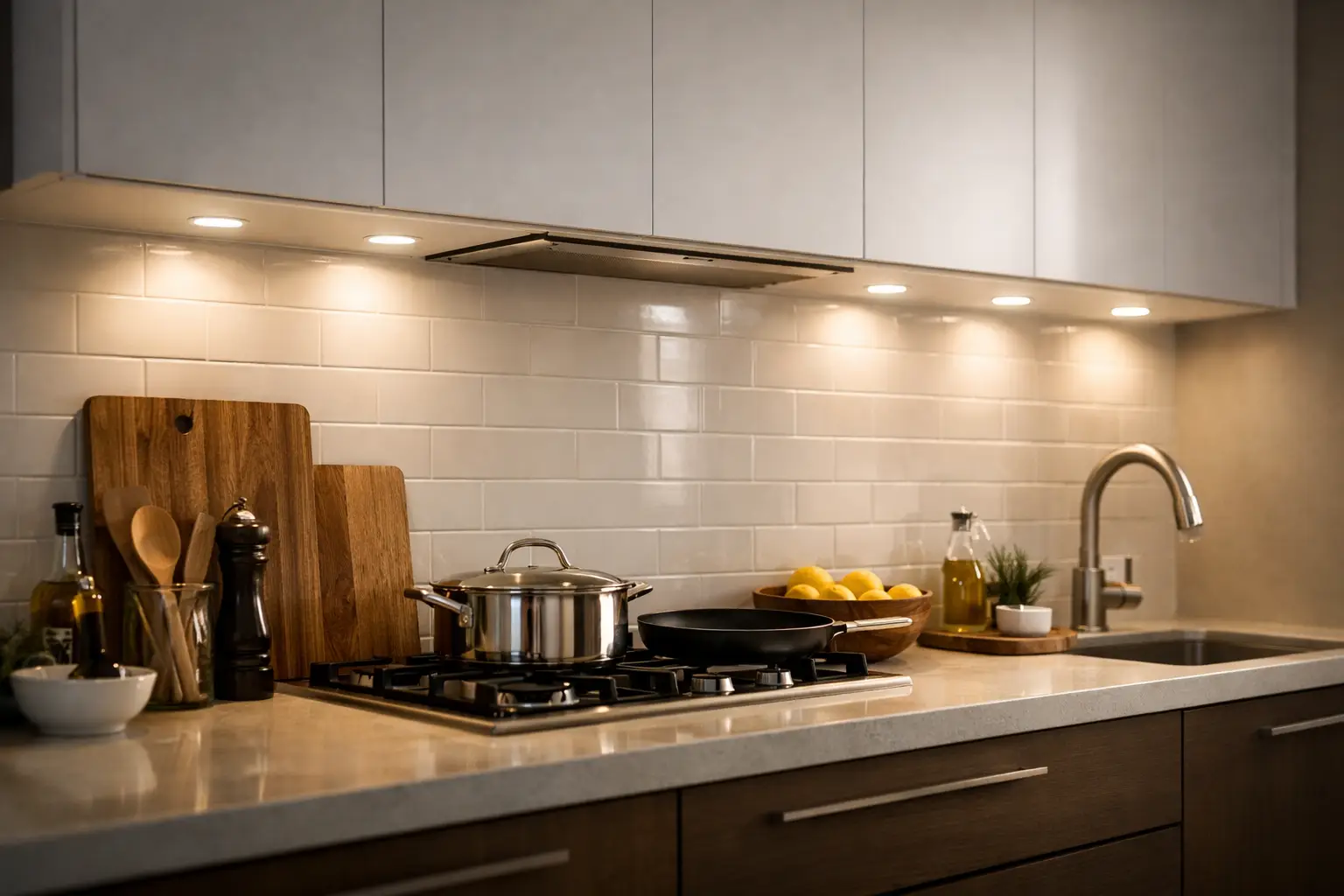
Overhead lighting has a habit of leaving you in your own shadow when standing at the counter. Under cabinet lighting fixes that practical problem first, but the design impact is just as valuable. It gives the kitchen more layers, and layered lighting is what separates a purely functional room from one that feels warm, modern and intentionally designed.
This is especially useful in open-plan spaces where the kitchen needs to work hard at different times of day. Bright task lighting is essential for chopping and cooking, but you may not want the room fully lit when the day winds down. A discreet line of light beneath the cupboards can keep the space usable while softening the overall mood.
There is also a visual benefit that many homeowners only notice once it is installed. Cabinets appear lighter, splashbacks gain depth, and premium materials such as quartz, stone and textured tiles tend to show far better under directional light than they do under a single central fitting.
Choosing the right type of kitchen under cabinet lighting
There is no single best option for every kitchen. The right choice depends on the cabinet design, the finish you want and whether the lighting is mainly decorative, task-focused or both.
LED strip lighting for a clean contemporary look
LED strip is often the most versatile route. It produces a continuous line of light that feels sleek and architectural, especially when fitted into an aluminium profile with a diffuser. That diffuser matters more than many people expect. Without it, individual diode dots can reflect on polished splashbacks and worktops, which can cheapen the effect.
This option works particularly well in modern kitchens with long uninterrupted cabinet runs. It is also ideal where you want the lighting to feel integrated rather than added on afterwards. For design-led projects, bespoke LED strip can make a big difference because lengths, outputs and profiles can be tailored to the exact layout rather than forced into standard sizes.
Under cabinet bars and linear fittings
Bar lights and slim linear fittings are practical, reliable and often easier to specify for straightforward installations. They suit utility-style kitchens, shaker kitchens and spaces where you want focused task light with minimal complexity. Many offer linking options, which can simplify installation across multiple cupboards.
The finish is usually a little more visible than concealed LED strip, so they are best chosen carefully. In the right setting, that is not a drawback. A neat, slim fitting can still look smart and refined.
Spot-style puck lights
Puck lights create pools of light rather than an even wash. That can work beautifully in smaller sections of cabinetry or where you want to highlight feature materials, but they are not always the strongest choice for full task coverage. You can end up with bright circles and darker gaps between them.
For some kitchens, that look is perfectly acceptable, particularly in more traditional interiors. If your priority is a smooth, premium effect across the whole worktop, strip or linear lighting tends to be the stronger option.
Getting the colour temperature right
Brightness matters, but the tone of the light often has a bigger effect on how the kitchen feels. Too cool, and the room can look stark. Too warm, and work surfaces may lose their crispness, especially in kitchens with white or grey finishes.
For most kitchen under cabinet lighting, a warm white to neutral white range creates the best balance. It keeps the space inviting while still feeling clean enough for task work. If the kitchen already includes warmer decorative pendants or wall lights, matching the under cabinet lighting too closely is not always necessary, but it should sit comfortably within the wider scheme.
This is where sample testing helps. A light source that looks perfect on paper can feel very different once it hits green tiles, oak cabinetry or a glossy splashback. Materials bounce light back into the room, so the same fitting can read warmer or cooler depending on the setting.
Placement makes or breaks the finish
Even high-quality fittings will underperform if they are placed badly. The ideal position is usually towards the front edge of the underside of the cabinet, not pushed right back against the wall. That helps the light fall across the full depth of the worktop rather than just washing the splashback.
Concealment is equally important. You want to see the effect of the light, not the source itself when standing or sitting nearby. Profiles, recessed channels and thoughtful positioning all help create that polished result.
Cable management should never be an afterthought. Visible wires can undermine an otherwise beautiful kitchen, so it is worth planning routes early, especially during a renovation. Retrofitting is absolutely possible, but the cleanest outcomes usually come when lighting is considered as part of the wider kitchen scheme.
Matching the lighting to your kitchen style
The best kitchen under cabinet lighting does not just illuminate surfaces – it supports the character of the room.
In contemporary kitchens, a continuous diffused LED line suits handleless doors, slim worktops and minimal detailing. It feels crisp and architectural, particularly when paired with stone, glass or matt finishes.
In more classic kitchens, softer linear fittings or discreet puck lights can sit more naturally beneath traditional cabinetry. The aim is not to make a period-inspired space suddenly look ultra-modern, but to improve function while keeping the overall look cohesive.
For darker kitchens, under cabinet lighting becomes even more valuable. Deep navy, charcoal and forest green cabinetry can look striking, but they absorb light. Bringing illumination down to worktop level stops the room feeling heavy and adds contrast that flatters richer colours.
Practical details worth thinking about
Dimming is often overlooked and then appreciated every day once installed. Full brightness is useful for prep, but a lower setting can make the kitchen far more comfortable in the evening. If your kitchen is part of an open-plan living area, this flexibility becomes even more important.
Sensor options can also be useful in the right home. They are convenient, but not everyone wants lights activating automatically while moving around the kitchen at night. A simple switched or dimmable setup is often the better long-term choice if you prefer full control.
Maintenance is another small but real consideration. Grease and cooking residue build up over time, so fittings should be easy to wipe down. Enclosed profiles and good-quality finishes tend to age better than exposed, budget-led products.
When bespoke is the better choice
Standard fittings can work perfectly well in a simple kitchen layout. But once you have corners, floating shelves, mixed cabinet depths or feature splashbacks, off-the-shelf options may start to feel limiting. That is where a more tailored approach earns its place.
Bespoke LED strip solutions allow for more precise lengths, neater integration and a finish that feels intentional from end to end. For homeowners investing in a new kitchen, or for trade and hospitality projects where consistency matters, that extra level of planning often shows in the final result.
It can also help avoid the common compromise of over-lighting one section and under-lighting another. Kitchens are rarely as standard as product packaging suggests.
Is it worth adding under cabinet lighting to an existing kitchen?
In many cases, yes. If the cabinetry is in good condition and the layout works, under cabinet lighting can refresh the whole room without the cost of replacing units or worktops. It is one of the smartest upgrades for making an existing kitchen feel more current.
The main question is how discreetly it can be installed. Some retrofits are very straightforward, while others need more careful planning around power access and cable routes. If you are already updating sockets, repainting or changing the splashback, that is often the perfect moment to include it.
For homes across Ireland where winter evenings arrive early and kitchens carry much of the household traffic, this type of lighting earns its keep quickly. It is not just about appearance. It makes the room easier to use, more comfortable to spend time in and far more considered visually.
Good kitchen lighting should never feel accidental. When under cabinet lighting is chosen with the same care as the cabinetry, worktop and hardware, the whole room settles into place. If you are updating your kitchen, this is one detail that quietly changes everything.