A dark side gate, a shadowed porch and an unlit route from the drive to the front door can make even a beautifully finished home feel less welcoming. This outdoor security lighting guide is designed to help you light those vulnerable areas with purpose, while keeping the exterior polished, comfortable and true to the character of your home.
Good security lighting is not about turning the garden into a floodlit car park. It is about creating clear sightlines, making access routes safer after dark and removing the deep pockets of shadow where people or obstacles disappear. The best schemes combine well-placed fittings, considered controls and warm, architectural light that looks as good at 7pm as it does at midnight.
Start with the areas that matter most
Walk around your property after dark before choosing a fitting. You will quickly see where light is genuinely needed: the front entrance, driveway, side passage, rear door, garage, shed, bin area and garden gate are usually the priority points. Also consider the everyday route you use to bring in shopping, put out the bins or let the dog into the garden.
The front door deserves more than a single harsh lamp above the frame. A pair of wall lights can make an entrance feel balanced and more inviting, while still giving clear visibility for keys, visitors and deliveries. Where there is little wall space, a downlight or compact exterior spotlight may be the better answer.
At the side or rear of a house, practical light often takes the lead. A discreet wall-mounted fitting above a door, paired with a sensor-controlled light covering the passage, gives useful coverage without leaving the area brightly lit all evening. For larger driveways or detached garages, a wider-beam LED floodlight may be necessary, but placement matters far more than simply choosing the highest wattage.
Choose the right type of outdoor security lighting
Different fittings solve different problems. Treating them as part of one exterior lighting scheme will produce a much more considered result.
PIR sensor lights for responsive coverage
Passive infrared, or PIR, sensors detect movement through changes in heat. They are a practical choice for entrances, side passages and rear gardens because the light activates only when someone approaches. That saves energy and creates an immediate visual response when a person enters the area.
Set the sensor carefully. If it faces a busy pavement, a road or a branch that moves in the wind, it can trigger constantly. Most quality fittings allow you to adjust sensitivity, detection range and how long the light stays on. Start with a modest range and a short duration, then fine-tune it over a few evenings.
Dusk-to-dawn lighting for dependable visibility
Photocell fittings switch on as natural light fades and turn off at daybreak. They suit locations that benefit from consistent, low-level illumination, such as a house number, porch, driveway edge or frequently used entrance.
This option works particularly well with decorative wall lights that provide a softer wash of light. It is less suited to a powerful floodlight, which can feel intrusive if it remains on throughout the night. Think of dusk-to-dawn fittings as background light, rather than the main security response.
Floodlights for large or difficult spaces
LED floodlights provide broad, bright coverage for driveways, yards, large patios and commercial service areas. They are useful where a person needs to be recognisable at a distance or where there are few mounting positions.
The trade-off is visual comfort. A poorly aimed floodlight can create glare, spill into a neighbour’s garden or shine back towards windows and cameras. Mount it high enough to cover the required area, angle it downwards and avoid pointing it directly towards an approaching person. More brightness does not always mean better security if the fitting leaves the viewer temporarily dazzled.
Wall lights, bollards and step lights for layered security
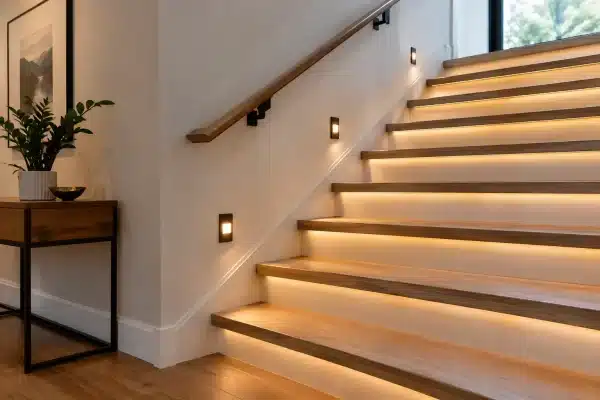
Decorative exterior wall lights, bollards and recessed step lights are often overlooked in security planning. Yet they play a valuable role by defining routes and reducing trip hazards without the stark look of a floodlight.
Use these fittings to guide movement from the gate to the door, across a patio or down external steps. They work especially well alongside sensor lighting: the pathway remains legible, while brighter light activates when someone enters the zone. This layered approach feels considered and gives the exterior a more premium finish.
Plan placement before you buy
A fitting can have excellent output and still underperform if it is installed in the wrong place. Aim light across a route or surface rather than directly at it. Side lighting reveals movement and depth more effectively than a flat beam aimed straight down from above.
At a front entrance, place light where it illuminates faces without casting heavy shadows from a canopy or projecting porch. At the side of a home, position the sensor so it sees someone approaching from both directions, not only once they are already beside the door. For gates and sheds, light the approach as well as the lock or handle.
Avoid creating contrast between intensely lit and completely dark areas. Your eyes take time to adjust when moving out of a bright pool of light, which can make the darker surrounding space harder to assess. A modest ambient layer from wall lights, bollards or low-level garden lighting helps the eye move comfortably through the space.
If your property has a CCTV system, check its position before finalising the scheme. Visible light can improve colour footage and make faces easier to identify, but a lamp aimed into the camera lens will reduce image quality. In some cases, a camera with infrared capability needs less visible light than you might expect. Test the angle before making a permanent installation.
Get brightness and colour temperature right
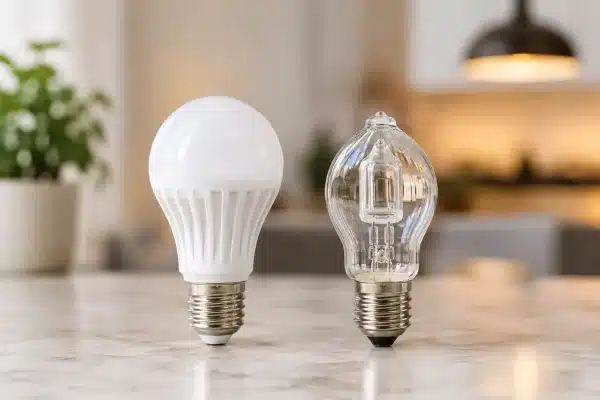
For exterior security, lumens are more useful than old-style wattage comparisons. Lumens measure the visible light output, although the required amount varies by mounting height, beam angle, surrounding darkness and surface colour.
As a general guide, a small entrance or side passage may need a modest fitting, while a broad driveway or rear yard may require more output and a wider beam. Rather than relying on one extremely bright source, consider two lower-output fittings placed to cover separate angles. The result is often more even, more attractive and less glaring.
Colour temperature has a strong effect on the feel of your exterior. Warm white light, around 2700K to 3000K, complements brick, stone, timber and traditional façades, making it a natural choice for wall lights and path lighting. Neutral white, around 4000K, can provide a crisper appearance for driveways, side passages and task-focused areas.
Cooler light can appear brighter, but it can also make a garden feel clinical and is more likely to look out of place beside a carefully designed entrance. Match the colour temperature across fittings that are visible together for a cleaner, more cohesive finish.
Check IP ratings and installation requirements
Outdoor fittings need protection from weather, moisture and dust. Look for a suitable IP rating, particularly in exposed positions. IP44 is commonly used for sheltered exterior walls where there is protection from direct driving rain, while IP65 offers stronger protection for more exposed locations and is a sensible choice for floodlights and open garden areas.
The location still matters. Even a weather-rated fitting will last longer when it is not constantly holding water, blocked by leaves or installed where cables are vulnerable to damage. Choose corrosion-resistant finishes where possible, especially in coastal settings where salt air can be hard on metalwork.
Any new fixed outdoor electrical work should be planned and installed by a qualified electrician. This is particularly relevant for mains-powered fittings, new circuits, outdoor sockets and connections near water. A professional can also advise on cable routes, switching, sensor placement and whether your existing exterior lighting circuit is suitable for the load.
Solar lighting can be useful for accenting a path or marking a garden boundary, especially where running cables is impractical. It should not be your only security measure in a heavily shaded garden or during darker winter months, when charging performance can be less reliable. Use it as a design layer, not a substitute for dependable wired lighting where safety is the priority.
Make security lighting part of the design
Security fittings no longer need to look purely utilitarian. Matte black wall lights suit contemporary render and dark-framed windows, while anthracite, stainless steel and classic lantern shapes can be selected to complement the architecture. The goal is to make every fitting look intentional in daylight as well as effective after sunset.
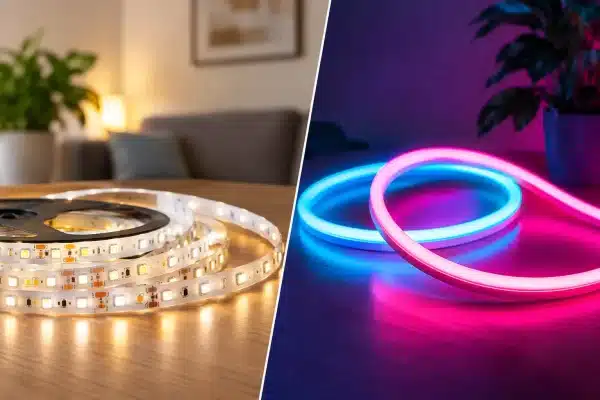
For renovation projects, plan exterior lighting alongside paving, planting, door hardware and house numbers. Concealed LED tape beneath a handrail, integrated step lighting or a carefully placed up-and-down wall light can bring structure to an entrance without cluttering it with visible equipment. For more complex homes, hospitality terraces or commercial premises, a tailored lighting plan can balance practical coverage with a strong visual identity.
Lux Lighting can help bring together decorative exterior fittings, practical security options and the design detail that makes the whole scheme feel considered. Begin with the route people take through your property after dark, then let each light make that journey clearer, safer and more inviting.