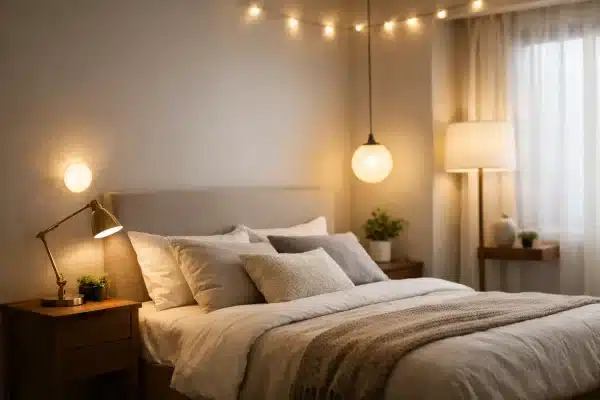
A bedside lamp is usually the last light you switch off, so it has more work to do than simply fill an empty corner of your bedside table. Knowing how to choose bedside lamps means balancing comfortable light for reading, a shape that suits the room, and a finish that makes the bed feel intentionally styled rather than hastily furnished.
The best choice is rarely the biggest, brightest or most decorative lamp on its own. It is the one that feels in proportion at bedtime, casts light where you need it and complements the wider bedroom scheme.
How to choose bedside lamps for your bed and room
Start with the bed, not the lamp. A compact double bed in a smaller room needs a more restrained design than a super-king with generous bedside tables and a tall upholstered headboard. Lamps should visually belong to the furniture around them, rather than appearing too slight beside the bed or crowding the surface.
As a useful guide, the combined height of your bedside table and lamp should usually sit close to the height of the top of your mattress. This allows the light to fall at a comfortable level when you are sitting up, without leaving the bulb exposed to your eyes. It is a guide rather than a rule: a high headboard can carry a taller lamp beautifully, while a low platform bed often looks better with a lower, broader design.
Scale matters just as much across the table. Leave enough room for the everyday essentials: a glass of water, a book, your mobile phone and perhaps a small tray. On narrow tables, choose a slim base, wall light or pendant rather than forcing an oversized lamp into a limited footprint. In a larger bedroom, a pair of small lamps can disappear visually, so a substantial ceramic, glass or metal base may be the better design decision.
Decide what the lamp needs to do
Bedside lighting often needs to support two very different moments: winding down in a calm, softly lit room, and reading without disturbing the person beside you. One lamp can do both, but only if you choose its shade, bulb and controls carefully.
For reading, direct light is helpful. A lamp with a relatively focused shade, an adjustable arm or an angled head sends more light towards the page. This is especially useful where one person reads in bed while the other sleeps. A directional reading light mounted beside the bed can also free up valuable table space.
For ambience, a fabric or opaque shade will diffuse the light and soften the bedroom. Linen-effect, pleated and textured shades bring warmth and visual depth, while clear glass, exposed bulbs and highly reflective finishes create a sharper, more contemporary effect. Neither is automatically right. A hotel-inspired bedroom with layered cushions and rich textures may suit a warm fabric shade; a clean-lined modern scheme may call for smoked glass or a sculptural metal lamp.
Dimmable lighting gives you more flexibility than a fixed-output lamp. You can keep the room bright enough for reading, then lower it for a gentler evening atmosphere. Just make sure the lamp, bulb and dimmer are compatible. If you prefer an easy upgrade, smart bulbs can give you adjustable brightness and, in some cases, tunable white light from the same fitting.
Choose a warm bulb for the evening
Bedrooms generally feel most inviting with warm white light. Look for a colour temperature around 2700K, which gives a comfortable, golden-white glow suited to rest and relaxation. Cooler white light can feel crisper, but it is often better reserved for task-led spaces such as utility rooms or detailed grooming areas.
Brightness depends on the lamp’s job. A decorative bedside lamp used mainly for atmosphere may only need a modest output. If it is your primary reading light, choose a brighter bulb or a dedicated reading fitting with controlled, directional illumination. The goal is not to flood the bedroom with light. It is to make your own side of the bed practical without turning the room into a workspace.
Get the shade and base proportions right
A beautifully designed lamp can still look awkward if the proportions are wrong. As a starting point, the shade should generally be narrower than the bedside table, so it does not overwhelm the furniture or create an unbalanced silhouette. A wider table gives you freedom to choose a more generous shade, which can make the bed feel more luxurious and grounded.
The bottom of the shade is equally important. When you are sitting in bed, it should sit around eye level or slightly lower, helping to conceal the bulb and reduce glare. If you can see the bare bulb from your usual reading position, the lamp is likely too tall, the shade too shallow, or both.
Consider the shape as well as the dimensions. Drum shades are clean and versatile, pairing well with contemporary ceramic bases and modern bedrooms. Tapered shades feel more traditional and can soften angular furniture. Globe-style lamps bring sculptural interest, but their diffused light may not be the strongest choice for dedicated reading unless paired with another task light.
Match the finish without making everything identical
Matching bedside lamps create a sense of order and are a reliable choice for symmetrical bedrooms. They work particularly well with centred beds, matching bedside tables and balanced wall art. A matching pair does not need to be plain, either. Statement bases in coloured glass, marble-look finishes, brass or textured ceramic can give symmetry plenty of personality.
That said, matching is not compulsory. In a more relaxed, layered bedroom, you might use two different lamps with a shared detail, such as the same shade colour, similar metal finish or comparable height. This approach can be ideal when your bedside tables are different, or when a single room needs to accommodate different practical needs on each side of the bed.
Look to the rest of the room for direction. Brass bedside lamps can introduce warmth beside timber furniture, while chrome, black and nickel finishes suit more tailored contemporary schemes. Soft neutral ceramics blend easily with linen bedding and natural textures. For a stronger focal point, choose colour deliberately: a deep green, cobalt, terracotta or patterned base can pick up tones from cushions, artwork or an upholstered headboard.
Think beyond table lamps when space is tight
A table lamp is familiar and flexible, but it is not always the best solution. Wall lights are excellent beside narrow bedside tables, in guest rooms and in compact flats where every surface needs to work harder. Choose adjustable wall lights for reading, or use a pair with shades for a more decorative, softly layered look.
Bedside pendants are another design-led option. Hung on either side of the bed, they create a polished boutique-hotel feel and leave tables clear for books and essentials. They need careful planning, especially where wiring is involved, so they are often best considered during a renovation or bedroom redesign.
For bedrooms that need several layers of light, combine bedside lamps with a central fitting, wardrobe lighting or subtle LED details. The bedside lamp should not be expected to light every corner. It is part of a scheme that makes the room feel useful in the morning and restful at night.
Do not overlook switches, cables and everyday use
The practical details are what make a lamp satisfying after the first week. A switch on the cable may be fine for occasional use, but an in-line dimmer, touch control or base switch can be much easier when you are settled under the duvet. If charging devices at night is part of your routine, a lamp with integrated USB charging can reduce cable clutter, although a well-placed socket remains the more flexible long-term option.
Check where the cable will run before buying. A beautiful lamp loses impact when its lead crosses a walkway or hangs visibly behind a floating bedside shelf. Consider plug locations, the direction the switch faces, and whether both sides of the bed can be turned off without anyone getting up.
If you are choosing a pair, test the practical balance. One partner may want a focused reading light; the other may prefer a low, ambient glow. Two complementary fittings can often serve the room better than two identical lamps chosen purely for symmetry.
A final bedside lamp checklist
Before committing, ask whether the lamp is sized for the table and mattress height, whether its shade hides the bulb from your seated eye line, and whether it gives enough warm light for how you actually use the bed. Then consider the finish, switch position and cable route.
The right bedside lamps make a bedroom feel considered at every hour. Choose the pair that supports your evening routine, reflects your style and makes switching off feel like part of the room’s atmosphere, not an afterthought.