A bathroom can look beautifully finished and still feel disappointing when the light is wrong. Shadows around the mirror, a harsh glare in the morning, or a fitting that feels too small for the room can quickly take the polish off a renovation. Knowing how to choose bathroom ceiling lights means balancing safe installation with the atmosphere you want to create – from a crisp family bathroom to a calm, hotel-inspired en suite.
The right ceiling light should give the room an even foundation of illumination, suit its proportions and work effortlessly alongside mirror and task lighting. Start with safety, then layer in brightness, colour temperature and a finish that belongs with the rest of your scheme.
Start with the IP rating and bathroom zones
Bathrooms are humid spaces, and the closer a light fitting sits to a bath or shower, the greater the protection it needs from water. This is where an IP rating matters. IP stands for Ingress Protection, and the two numbers indicate how well the fitting is protected against solids and moisture. For bathroom lighting, the second number is the key one.
Bathroom zones are used to determine which fittings can be installed in particular areas. Zone 0 is inside the bath or shower itself and requires very high protection, typically IP67. Zone 1 covers the area directly above a bath or shower up to 2.25 metres from the floor. Zone 2 extends 60cm beyond Zone 1, as well as around a basin where splashes are likely.
A fitting rated IP65 is a popular, flexible choice for shower areas because it has a strong level of water protection. IP44 fittings are commonly suitable for areas away from direct spray, such as much of Zone 2 and the wider bathroom. The exact requirements depend on the layout and installation, so always ask a qualified electrician to confirm the zones and fitting suitability before work begins.
Do not treat the IP rating as an optional technical detail. A decorative ceiling light may suit the look you have in mind, but it is not the right choice if it is positioned where moisture protection is required. There are plenty of stylish bathroom-safe options, so safety does not need to limit the design.
How to choose bathroom ceiling lights for the right level of brightness
Ceiling lighting should make the whole room feel clear, comfortable and easy to use. It is your ambient lighting layer, rather than the sole source of light for every task. A single central fitting can work well in a compact cloakroom, but larger bathrooms usually benefit from multiple fittings that spread the light more evenly.
Look at lumens rather than relying on wattage. Lumens tell you how much usable light a lamp or integrated LED fitting produces. As a broad starting point, a small bathroom may need around 1,500 lumens of general ceiling lighting, while a larger bathroom with darker finishes, no natural daylight or a separate shower enclosure may need 2,000 to 2,500 lumens or more.
These figures are a guide, not a fixed rule. Deep green tiles, charcoal cabinetry and matte black finishes absorb more light than white gloss surfaces. A room with a generous window needs less artificial illumination during the day, but it still needs a reliable scheme for dark winter mornings and evenings.
Downlights are often the easiest way to create even coverage. In a standard bathroom, four carefully positioned downlights can feel far more luxurious than one powerful central light because they reduce dark corners and prevent a pool of glare in the middle of the ceiling. Avoid placing them in a rigid grid without considering the room layout. Positioning should respond to the shower, vanity, bath and doorway.
Do not rely on ceiling lights at the mirror
Even a bright bathroom ceiling light creates shadows beneath the eyes, nose and chin. For shaving, applying make-up or skincare, the most flattering and practical light comes from the front or both sides of the face.
Pair your ceiling lights with an illuminated bathroom mirror, vertical wall lights or a pair of well-positioned mirror lights. The ceiling layer then handles circulation and overall ambience, while the mirror lighting makes daily routines easier. This combination feels more considered and gives you the flexibility to use softer light later in the evening.
Choose a colour temperature that suits the room
The colour temperature of an LED is measured in Kelvins and has a major effect on how tiles, paint and skin tones appear. It is one of the details that separates a bathroom that simply feels bright from one that feels inviting.
Warm white, around 2700K, creates a relaxed glow and works especially well in spa-style bathrooms with timber, brushed brass, natural stone and soft neutral finishes. It can be lovely for bathing, although it may feel slightly too warm for detailed grooming if used alone.
For most homes, 3000K is the sweet spot. It is warm enough to feel comfortable, yet clean enough to make a bathroom feel fresh and functional. If you prefer a sharper, more contemporary look, 4000K gives a cooler neutral white that works well with crisp white sanitaryware and modern tile schemes. It can be excellent at the mirror, but in a small bathroom it may feel clinical if the rest of the lighting is equally cool.
Where possible, choose LEDs with a high colour rendering index, ideally CRI 90 or above. Better colour rendering helps whites look cleaner, timber look richer and skin tones look more natural. This is particularly worthwhile in bathrooms with statement tiles, coloured vanity units or carefully chosen finishes.
Match the fitting style to the ceiling and layout
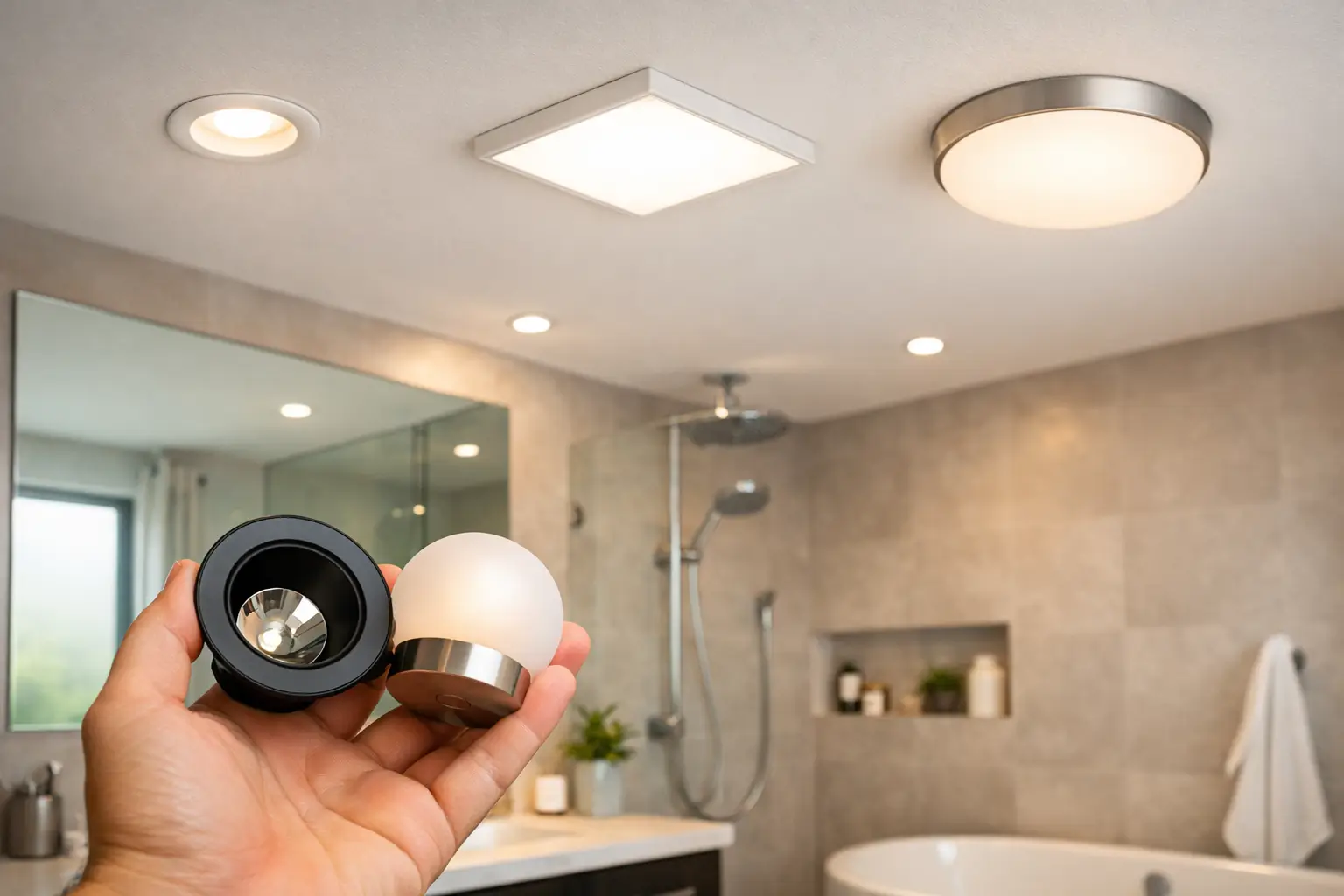
Recessed downlights suit almost every modern bathroom because they are discreet, practical and easy to distribute across the room. Choose a bezel finish that supports the wider scheme. White blends into a white ceiling, chrome adds a classic reflective touch, while black or brass can tie in with taps, shower frames and accessories.
For a bathroom with sufficient ceiling height and a fitting positioned well away from wet zones, a flush ceiling light can bring more decorative character. Opal glass gives a soft, diffused glow, while a slim metal-and-glass design can introduce a more tailored, architectural look. A flush fitting is especially useful where you want a feature but do not have the ceiling height for a pendant.
Semi-flush fittings can work in larger bathrooms, but scale is crucial. Anything that hangs too low can make the ceiling feel lower and may interfere with sightlines around a shower screen. In most standard-height bathrooms, keep the main fitting close to the ceiling and use wall or mirror lighting to add personality at eye level.
If you are renovating a period home, do not assume you must choose something traditional. A simple opal globe, ribbed glass flush light or softly curved brass fitting can bridge classic architecture and contemporary brassware without making the room feel themed.
Decide between integrated LEDs and replaceable lamps
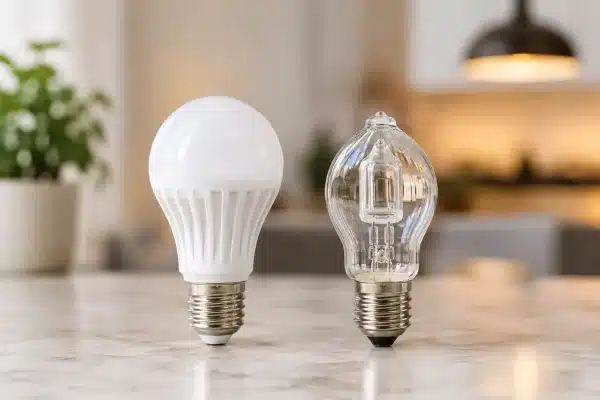
Many bathroom ceiling fittings now use integrated LEDs. They tend to be slim, energy-efficient and visually clean, making them ideal for modern flush lights and downlights. Their trade-off is that the LED component is built into the fitting, so replacement is not as straightforward as changing a bulb.
GU10 downlights and other replaceable-lamp fittings give you more freedom to alter the beam angle, brightness and colour temperature later. They are a sensible option if you want long-term flexibility or prefer to replace a lamp rather than the fitting. The quality of the lamp matters, though. A cheap bulb can undermine an otherwise beautiful fitting with poor colour rendering, flicker or an uneven beam.
Whichever route you choose, check whether the fitting is dimmable and make sure the dimmer is compatible with the LED driver or lamps. Dimming is one of the best upgrades for a bathroom. Bright light is useful when getting ready; a lower level makes an evening bath feel far more restful.
Plan the practical details before ordering
A good lighting plan considers more than the fitting visible from below. Downlights need enough space in the ceiling void, and some installations may call for fire-rated fittings depending on the ceiling construction and building requirements. An electrician can assess this before holes are cut, which is much easier than trying to redesign the scheme later.
Also consider extraction. A powerful extractor fan helps reduce condensation and protects finishes over time, but it does not remove the need for correctly rated bathroom lights. If your room has a low ceiling, limited natural light or frequent condensation, choose quality fittings designed for the environment rather than trying to adapt standard indoor lights.
Before finalising quantities, mark the bath, shower, vanity and door swing on a simple plan. This reveals whether a proposed central light will be blocked by an open door, whether the vanity needs its own downlight, and where you may want a softer pool of light near the bath. For complex layouts, a professional lighting plan can turn a collection of fittings into a scheme that feels balanced from every angle.
The best bathroom ceiling lights disappear into the experience of the room: bright and clear when the day begins, softer when you need to slow down, and always in harmony with the finishes you have chosen. Take the time to get the layout and light quality right, and your bathroom will feel considered long after the renovation dust has settled.