A pendant above the dining table can look exactly right, yet still feel wrong when its light is too harsh for dinner or too dim for homework. That is where smart bulbs vs smart switches becomes a useful design decision, not just a technology question. Both can give you better control of brightness, ambience and routines, but they work in very different ways – and one will usually suit your room, fitting and renovation plans better.
For a single lamp or an easy first step into smart lighting, bulbs are often the natural choice. For a kitchen, hallway or whole-home scheme where the wall switch needs to work brilliantly for everyone, smart switches can be the smarter long-term investment.
Smart bulbs vs smart switches: the key difference
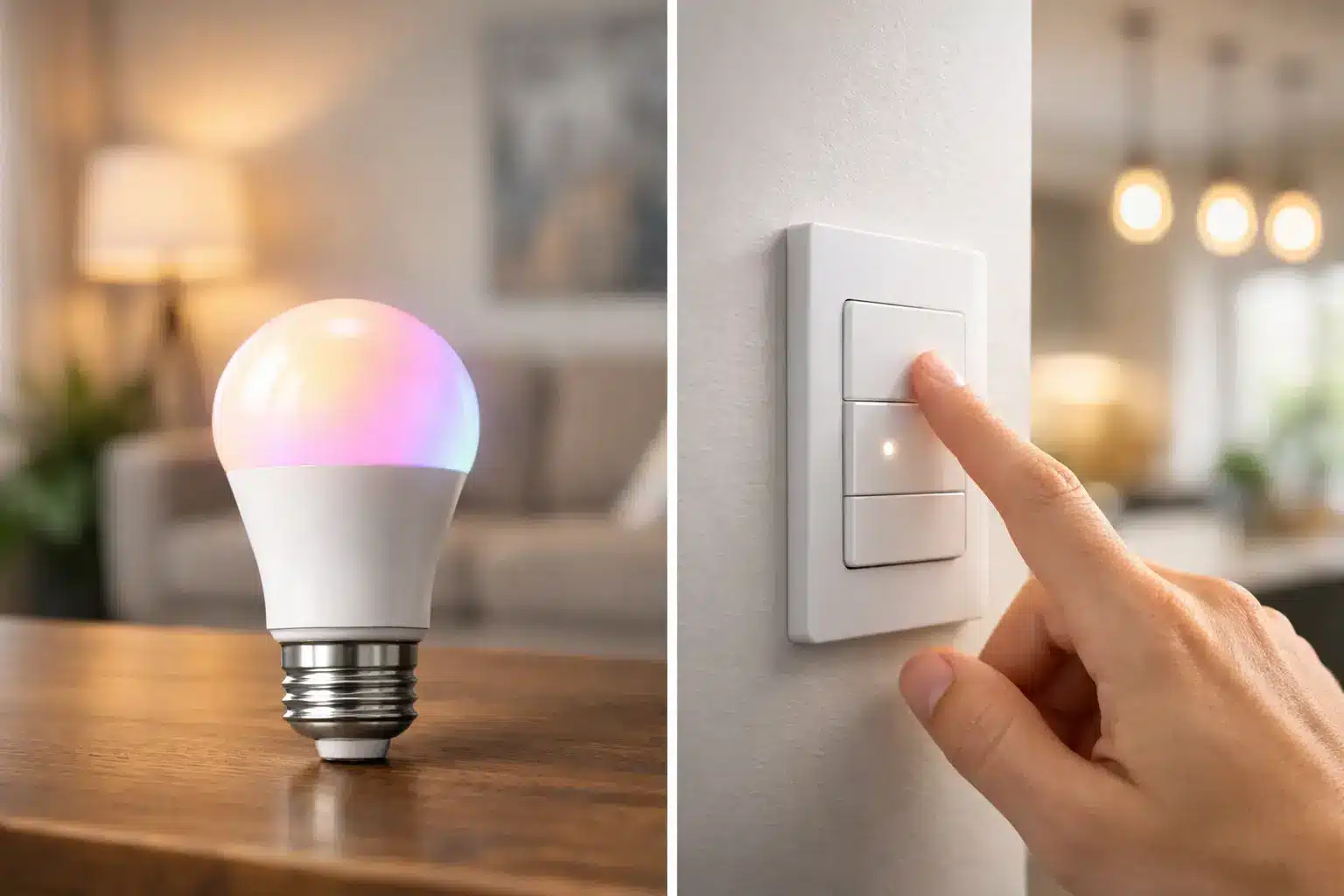
A smart bulb replaces the bulb inside a lamp or light fitting. It connects to an app, voice assistant, remote control or smart-home hub, allowing you to switch it on and off, dim it and, on colour-capable models, change the colour temperature or create coloured light. It is a quick way to make one light source more flexible.
A smart switch replaces, or sits behind, the existing wall switch. Rather than making the bulb intelligent, it controls the power going to the lighting circuit. One switch can therefore operate several standard bulbs at once, provided they are on the same circuit. Depending on the product, you may gain app control, scheduling, dimming and scene settings while keeping familiar wall control.
The crucial difference is this: smart bulbs need continuous power to remain connected. If somebody turns off the ordinary wall switch, the bulb is no longer smart until that switch is turned back on. A smart switch avoids that frustration because the switch itself is the connected control point.
Choose smart bulbs when flexibility matters most
Smart bulbs are particularly effective in rooms where lighting comes from individual lamps, or where you want to change the atmosphere without touching the wiring. Think bedside lamps, a reading corner, a floor lamp beside the sofa, or a feature pendant over a table.
They are also the more approachable option for renters and for anyone who wants to test smart lighting before committing to a larger scheme. In most cases, you simply fit the bulb, pair it with its chosen control system and set your preferred routines. If you move house, it can move with you.
The design advantage is colour and tunable white. A warm white setting can soften a living room in the evening, while a crisper white can support focus at a desk or vanity mirror. In a child’s bedroom, subtle colour scenes can make bedtime feel more playful, provided the main lighting still gives practical, comfortable illumination.
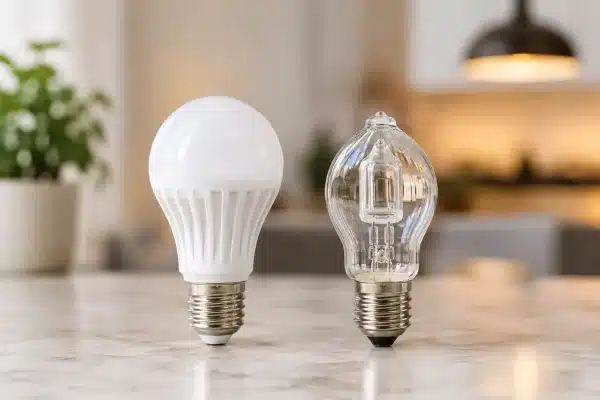
Smart bulbs suit decorative fittings too, but check the specification before you buy. An exposed-filament lamp, a small candle bulb or a particular cap fitting may not be available in every smart range. Large statement chandeliers can also become expensive if they need eight, ten or twelve smart bulbs.
There is another practical consideration: not every bulb should be dimmed in the same way. If you install a smart bulb, leave any existing wall dimmer at the required setting or replace it as advised by the manufacturer. Pairing a smart bulb with an incompatible dimmer can cause flickering, buzzing or unreliable performance.
When smart switches make better sense
Smart switches come into their own where one wall control operates multiple lights. Kitchens are a prime example. A single switch may control several downlights, a central fitting and perhaps under-cabinet lighting on separate circuits. Making those circuits smart at the switch can be more cost-effective, tidier and easier to live with than fitting a smart bulb into every ceiling fitting.
Hallways, landings, utility rooms and exterior lighting are also strong candidates. These are spaces where people expect the switch to work immediately, including guests, children and anyone who does not use your app. A well-chosen smart switch gives you that ordinary, intuitive control alongside scheduling and automation.
For a renovation, switches can create a more considered finish. Matching smart switch plates with sockets and other hardware helps the room feel designed rather than assembled over time. In a contemporary kitchen or a hospitality project, that visual consistency matters as much as the convenience of setting scenes.
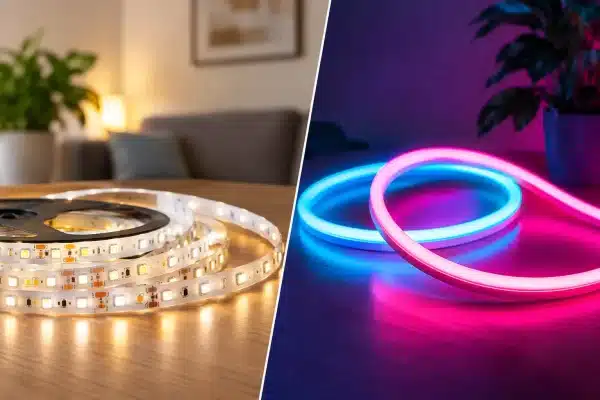
Smart switches are often more practical with integrated LED fittings. Many decorative pendants, slimline ceiling lights and bespoke LED strip systems do not use replaceable standard bulbs. A compatible smart switch or controller can offer intelligent control without compromising the fitting’s intended look.
Installation is the trade-off. Some smart switches need a neutral wire at the switch position, while others are designed to work without one. Older Irish and UK homes can vary considerably, so never assume the wiring behind one switch matches another room. Any work on fixed electrical wiring should be assessed and completed by a qualified electrician. It is a small step that protects both safety and the finish of your project.
Consider the bulb count, not just the unit price
A smart bulb may look less expensive at first, especially if you only need one or two. But multiply that price across a six-light kitchen ceiling and the picture changes. A smart switch controlling that circuit may offer better value, while allowing you to choose high-quality standard LED bulbs for the fittings.
Conversely, a smart switch can be poor value for a plug-in table lamp. A smart bulb gives direct control with no electrical work and lets you adjust that one pool of light independently from the rest of the room.
The everyday experience: control, routines and guests
The best smart lighting should not make a home harder to use. Before choosing either option, think about how the room works at 7am, during busy evenings and when visitors stay.
Smart bulbs excel at individual control. You can keep a reading lamp on while turning off a nearby floor lamp, or dim only the pendant above the dining table. They are ideal for layered lighting, where different sources create depth and purpose rather than relying on one central ceiling light.
Smart switches excel at reliable shared control. A single press can bring on all the downlights in a kitchen, while an evening scene can lower their output for a calmer finish after dinner. In a hallway, a timed schedule can welcome you home without leaving lights running all night.
Voice control is useful, but it should be an extra rather than the only way to operate the room. A physical switch remains reassuring when your phone is charging, the Wi-Fi is playing up or somebody simply wants to turn on the light without issuing a command.
For outdoor lighting, switches and dedicated smart controllers are usually the more durable route. Garden wall lights, driveway fittings and exterior LED tape often form part of a fixed circuit, where dependable scheduling and manual override are more valuable than coloured bulbs. Always choose fittings and controls rated appropriately for the location.
Colour, dimming and the atmosphere of the room
If your priority is changing the character of a room, smart bulbs offer the widest creative range. Tunable white lets you move from a bright, cleaner daytime light to a warmer evening glow. Colour should be used with intention: a low amber tone behind a television can feel inviting, while vivid colours are better saved for occasional entertaining, gaming spaces or children’s rooms.
Smart switches are usually the stronger choice for elegant, consistent dimming across a group of lights. The result can feel more architectural – downlights softened across a kitchen island, wall lights lowered in a dining room, or a run of LED strip lighting adjusted to accent joinery without overwhelming it.
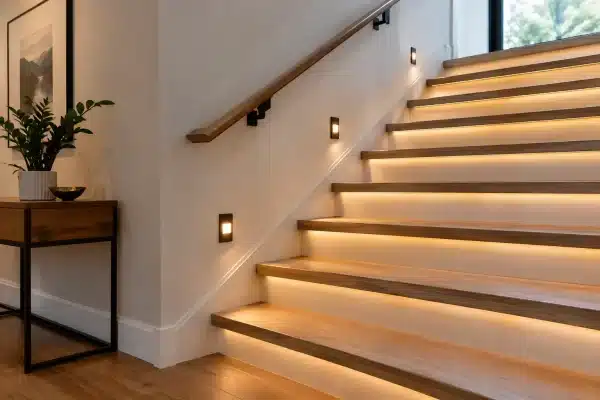
Dimming performance depends on the entire setup. The switch, driver, bulb or LED fitting must be compatible. This is especially relevant for LED tape, where the driver and controller need to be specified together. For a bespoke shelving detail, stair lighting scheme or bar project, planning the controls early avoids visible components, awkward access points and disappointing light output later.
A room-by-room way to decide
In the living room, smart bulbs often work beautifully in table and floor lamps, while a smart switch can manage the main ceiling fitting or wall lights. Combining the two gives you flexible layers without making every light source complicated.
In the kitchen, smart switches are usually the practical foundation for ceiling lights and task lighting. Add smart bulbs only where a decorative pendant or occasional lamp deserves separate colour or brightness control.
In bedrooms, smart bulbs are an easy win for bedside lamps because each person can control their own side. A smart switch for the main light is useful if you want a simple all-off routine at bedtime.
In bathrooms, select products suited to the zone and ensure the installation meets the relevant electrical requirements. Smart controls can be excellent for mirror lighting and softer evening settings, but safety and correct IP ratings always come first.
For a whole-home renovation, decide whether you want bulb-led flexibility or switch-led consistency before choosing decorative fittings. Lux Lighting can help bring the decorative, functional and project-led parts of that conversation together, particularly where bespoke LED strip lighting forms part of the plan.
The most satisfying choice is rarely about having the most app-controlled lights. It is about walking into a room and finding the right light already waiting for the moment – practical when you need it, softer when you do not, and always in keeping with the space you have created.