A kitchen island can look beautifully finished yet still feel flat after dark. The choice between track lighting vs downlights often decides whether a room simply has light or has real atmosphere, focus and depth. Both are smart, contemporary options, but they do very different jobs. Choosing well means thinking beyond the fitting itself and considering what happens in the room every day.
Track lighting vs downlights: the key difference
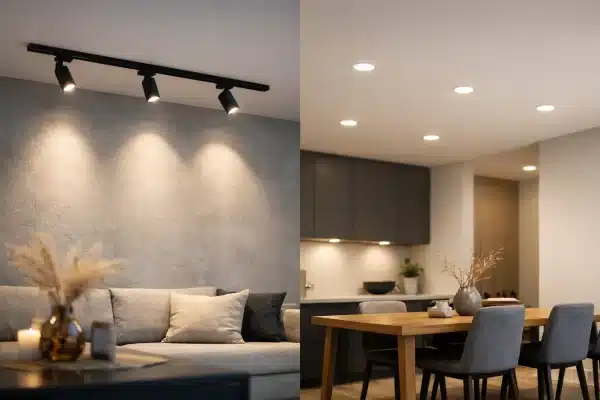
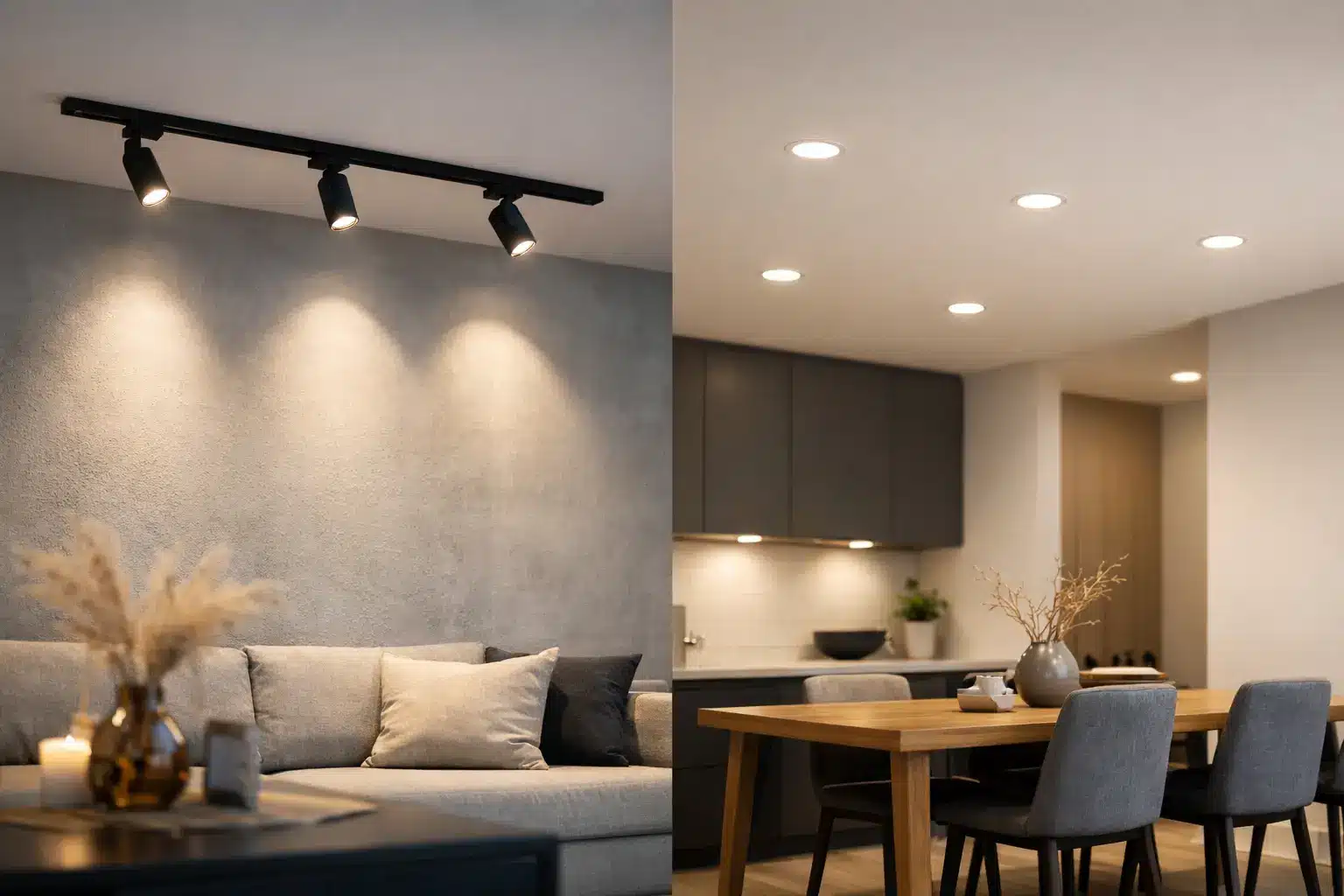
Track lighting uses adjustable spotlights mounted along a visible track. Each head can be aimed where it is needed, whether that is a worktop, artwork, shelving, a dining table or a feature wall. It is directional, architectural and naturally suited to rooms where the furniture, displays or focal points may change.
Downlights sit recessed into the ceiling and cast light straight down, usually in a wide, even pool. When planned carefully, they create a clean ceiling line and a calm, uncluttered finish. They are particularly effective for ambient light in kitchens, bathrooms, hallways and rooms with lower ceilings.
Neither is automatically the better choice. Downlights are often the quiet foundation of a lighting scheme, while track lighting makes a stronger visual statement and gives you more control over where light lands.
Choose downlights for a clean, even finish
Downlights work best when the goal is discreet, practical illumination. In a modern kitchen, a considered grid of dimmable downlights can light the circulation space and general room area without competing with cabinetry, pendants or decorative finishes. In a hallway, they can guide the route through the home without filling a narrow ceiling with visual detail.
The appeal is simplicity. A good recessed fitting largely disappears when switched off, allowing materials, furniture and architecture to take centre stage. This makes downlights especially useful in open-plan homes where several decorative fittings are already doing the styling work.
Their limitation is direction. Once installed, the position is fixed. Adjustable downlights offer some movement, but they cannot match the range and precision of track heads. A row placed solely to brighten the middle of a room may leave wall art, tall units and work surfaces looking underlit.
Spacing matters too. Installing too many downlights is one of the fastest ways to make a home feel more like a retail unit than a place to relax. Rather than treating them as the only source of light, use them as one layer alongside pendants, wall lights, lamps or LED strip lighting.
Where downlights shine
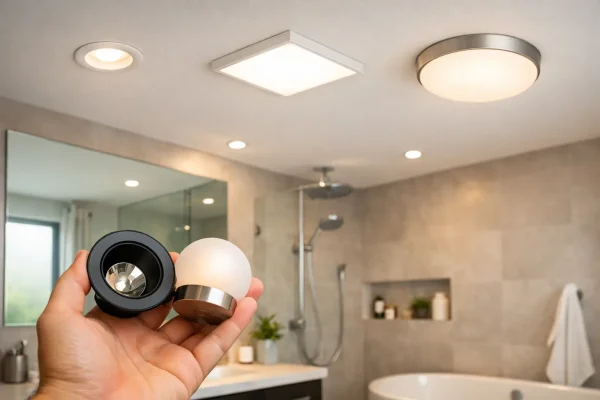
Bathrooms are a natural fit, provided fittings have the correct IP rating for their zone. Kitchens, utility rooms, cloakrooms, entrances and dressing areas also benefit from their compact, practical light. For living rooms and bedrooms, fewer downlights on a dimmer usually feel more considered than a bright ceiling grid.
Warm white light is generally the most inviting choice for living spaces. Kitchens and task-heavy areas can suit a slightly cooler white, but the final choice should complement the finishes in the room and the atmosphere you want after sunset.
Choose track lighting when flexibility matters
Track lighting brings a more intentional, design-led feel to a ceiling. It works particularly well above kitchen islands, across long dining areas, in converted spaces with exposed features, and in living rooms where you want to pick out art, bookshelves or textured walls. The track itself becomes part of the composition rather than something to hide.
The great advantage is adjustability. You can angle heads away from glossy surfaces, direct light towards a dark corner or re-aim the scheme after rearranging furniture. For homeowners who refresh their interiors regularly, that flexibility is genuinely useful rather than merely decorative.
Track is also a strong option for commercial interiors. Boutiques, cafés, bars and hospitality spaces need light that can adapt to changing displays, table layouts and seasonal styling. A well-planned track lets the room evolve without repeated ceiling alterations.
The trade-off is that track lighting is more visible. In a period home with ornate ceilings or a compact room with little ceiling height, it may feel too dominant. It needs enough visual breathing room and should be chosen in a finish that supports the wider scheme. Black track creates definition against a pale ceiling, while white tends to blend in more gently. Brass or bronze details can bring warmth where the rest of the room has a softer, more decorative character.
Track lighting is not only for industrial interiors
The idea that track lighting belongs only in loft-style spaces is outdated. Slimline systems, refined finishes and compact spot heads can feel polished in contemporary kitchens, elegant dining rooms and calm Scandinavian-inspired interiors. The secret is restraint. Select a track length that suits the room, avoid overfilling it with heads and use the fittings to highlight something worth looking at.
Consider the room before the fitting
A lighting plan should start with activity, not a product name. Ask where people cook, read, work, eat, get ready and relax. Then look for the features that deserve emphasis: a kitchen worktop, an artwork collection, a beautiful stone splashback, a gallery wall or a statement piece of furniture.
In a kitchen, downlights can provide general coverage while track heads bring targeted illumination to tall cabinetry, open shelves or the end of an island. If the island is the social centre of the room, decorative pendants may still be the better focal point, with track or downlights supporting them.
In a living room, track lighting is excellent for layering light onto walls and features, but it should rarely be the only source. Add table lamps or floor lamps at seating level to soften the room. Downlights can work here too, especially around the perimeter on separate circuits, but avoid placing them directly above sofas where their downward beam can create unflattering shadows and unnecessary glare.
For bedrooms, subtlety wins. Recessed downlights are useful around wardrobes or circulation areas, while bedside lights deliver the more comfortable light needed for winding down. Track lighting can suit a larger contemporary bedroom or dressing space, though it is usually best kept away from the central area above the bed.
Glare, beam angle and dimming make the difference
The most attractive fitting can still disappoint if the light is too harsh. Glare is common when a powerful spot is aimed into sightlines, reflected in polished worktops or positioned directly above a dining chair. With track lighting, take time to adjust each head after installation. Aim across a wall or towards a surface, rather than into people’s eyes.
Beam angle affects the result. A narrow beam creates drama and definition, ideal for a picture, niche or display. A wider beam gives softer coverage and is more useful for general lighting. The right mix often creates a far richer effect than using one beam angle everywhere.
Dimming is equally valuable. It allows bright, functional light for preparation and cleaning, then a lower setting for dinner or an evening at home. If you are combining track lighting, downlights and decorative fittings, separate circuits provide the best control. You can illuminate only what the moment requires instead of switching every light on at once.
Installation and ceiling practicalities
Downlights require ceiling void space and careful consideration of insulation, fire protection and driver access. In some properties, particularly renovations, the ceiling construction may limit where fittings can be placed. Fire-rated downlights are commonly required where the ceiling forms part of a fire barrier, while bathroom fittings need the right IP rating for their location.
Track lighting can sometimes be more straightforward where there is limited recess depth, as it mounts to the surface. However, the electrical feed and track position still need proper planning. A track cannot solve a poorly placed lighting point without suitable electrical work.
For either option, use a qualified electrician and confirm dimmer compatibility before ordering. LED technology is efficient and long-lasting, but fittings, lamps, drivers and dimmers must work together for smooth, flicker-free performance.
A layered scheme usually gives the best result
The strongest interiors rarely rely on a single ceiling-lighting solution. Downlights can form the understated base, while track lighting adds focus and movement. Decorative pendants introduce personality, wall lights create a welcoming glow and LED strip lighting brings a refined finish beneath cabinets, inside joinery or along architectural details.
For a renovation or a more complex home, it can be worth planning the full scheme before finalising ceiling positions. Lux Lighting’s design-led approach is especially useful when a kitchen, living area or hospitality space needs both practical coverage and a distinctive look.
Choose downlights when you want the ceiling to disappear and the room to feel evenly lit. Choose track lighting when you want adaptable, directional light that becomes part of the design. Most importantly, leave room for softer layers: the spaces people remember are not simply the brightest ones, but the ones that feel right at every hour.