A kitchen can look expensive, polished and beautifully planned – then feel strangely gloomy the moment the sun drops. That usually comes down to one thing: the downlights were guessed, not designed. If you are wondering how many downlights in kitchen layouts actually make sense, the real answer is not a fixed number. It depends on the room size, ceiling height, kitchen shape, colours, and what else is doing the lighting.
The good news is that there is a simple way to think about it. Get the balance right and your kitchen feels brighter, cleaner and far more considered. Get it wrong and you end up with dark worktops, glare where you do not want it, or a ceiling full of fittings that still do not make the room feel right.
How many downlights in kitchen layouts usually need?
For most standard family kitchens, you are usually looking at somewhere between 6 and 12 downlights. A compact galley kitchen may only need 4 to 6, while a larger open-plan kitchen with an island often needs 10, 12 or more. That sounds broad because it is – kitchens vary hugely, and downlights should support the room rather than follow a one-size-fits-all rule.
A small kitchen measuring around 3m x 3m might work well with 6 downlights if the beam angle and brightness are right. A room closer to 4m x 5m may need 8 to 10. If you have a large extension with a kitchen, dining and living zone all flowing together, the kitchen area should still be planned as its own task-focused space, even if the fittings line up visually across the ceiling.
What matters most is not just the quantity, but whether the light lands where you actually use it. Chopping vegetables at a worktop, reading recipes, cleaning, and serving at an island all need practical light. A kitchen that only looks evenly lit from the doorway is not necessarily well lit where it counts.
Start with layers, not just a number
Downlights are often treated as the entire kitchen lighting plan. That is where many schemes fall flat. In a well-designed kitchen, downlights usually provide the general lighting, but they work best when paired with other fittings.
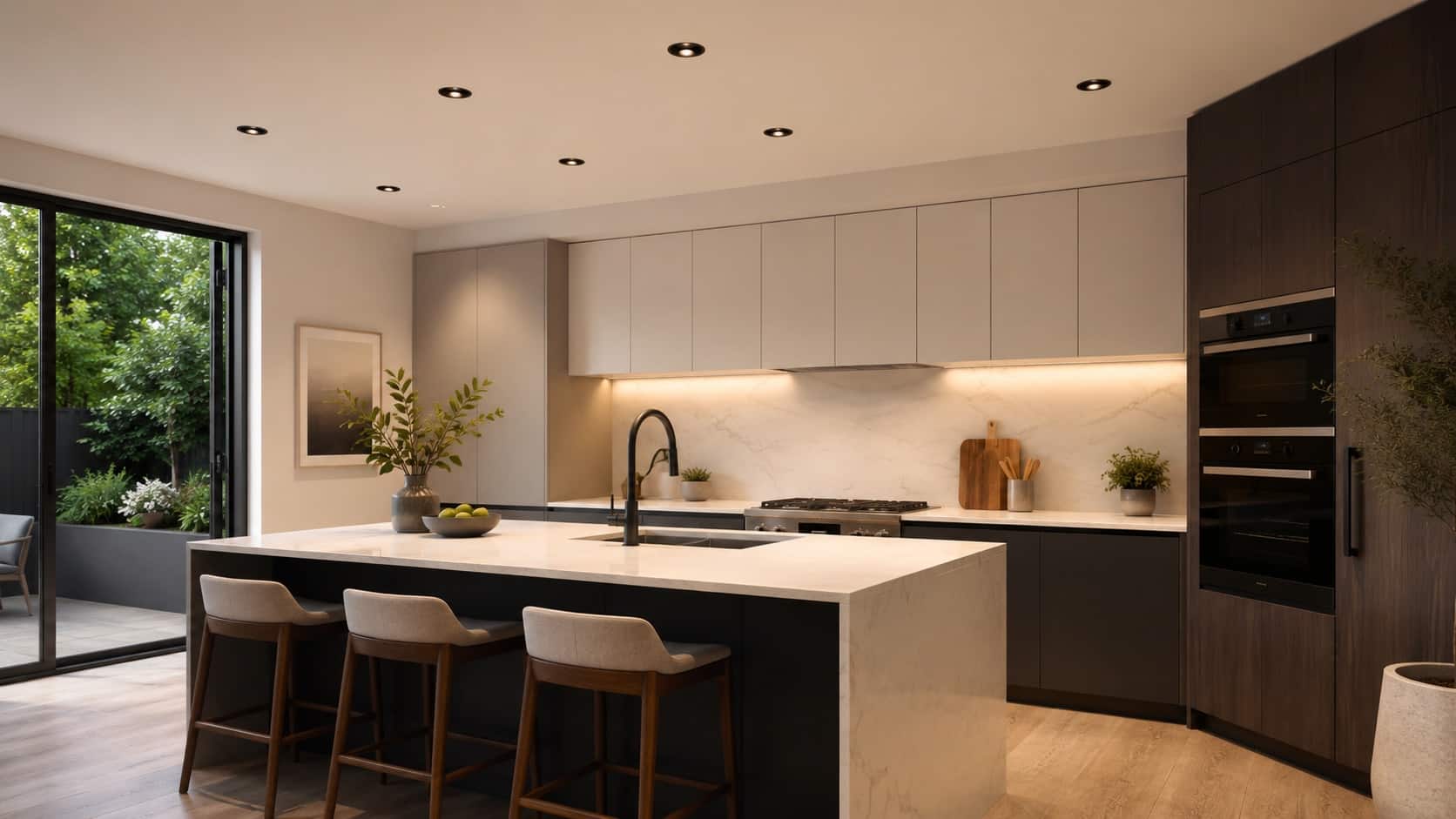
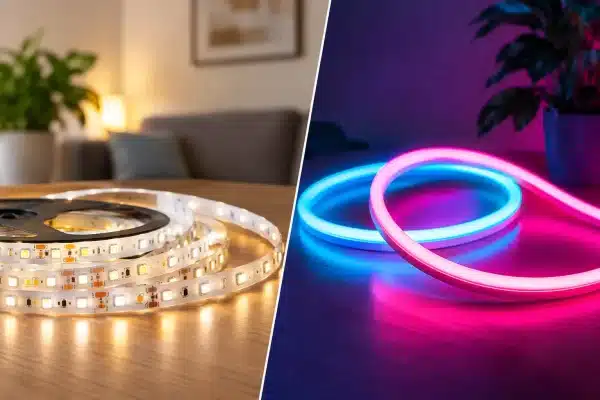
Under-cabinet lighting is one of the biggest upgrades you can make. It lights the work surface directly and removes the shadows that happen when ceiling lights sit behind you. Pendant lights above an island or breakfast bar add focus and style. Wall lights, LED strip details, or plinth lighting can soften the room and create atmosphere in the evening.
If your kitchen includes these extra layers, you may need fewer downlights than you think. If you are relying on downlights alone, you may need more output – though not necessarily more fittings – to make the space work.
The simplest way to plan kitchen downlights
A practical starting point is to space downlights around 1.2m to 1.5m apart in an average kitchen, with the outer row positioned about 60cm to 75cm from the wall. That tends to give a more even wash of light across worktops and floor areas.
But spacing should always be adjusted around the kitchen layout, not forced into a perfect grid. Cabinets, tall units, a cooker hood, rooflights and island positioning all affect where fittings should go. In many kitchens, a neat symmetrical ceiling plan looks satisfying on paper but misses the points that need light most.
Think of the working areas first. You want light in front of you when standing at the sink or prep area, not directly behind your head. That usually means downlights should be aligned with the front edge of the worktop run rather than centred in the walkway alone. It is a small shift that makes a noticeable difference.
A quick room-size guide
As a loose guide, a 9 square metre kitchen often suits 5 to 6 downlights. A 12 to 15 square metre kitchen may need 6 to 8. A 20 square metre kitchen could require 8 to 12 depending on ceiling height, finish colours and whether pendants or LED strips are included.
Use that as a starting point, not a rulebook. A dark kitchen with matte cabinetry and little natural light will usually need more from its lighting scheme than a bright white space with large glazing.
Brightness matters as much as fitting count
People often focus on how many fittings they need and ignore how bright each one is. That is a mistake. Six weak downlights can leave a kitchen underlit, while six high-quality LED downlights with the right beam angle can do a far better job.
For general kitchen lighting, you will typically want a brighter, cleaner level than in a bedroom or lounge. Many kitchens benefit from a total light output somewhere around 3,000 to 5,000 lumens for the main area, and more for larger open-plan rooms. The exact figure depends on the size and finish of the room, but it gives you a more useful target than simply counting fittings.
Colour temperature matters too. In kitchens, many people prefer a crisp but welcoming white light. Around 3000K often feels warm and stylish without looking yellow, while 4000K creates a sharper, more functional feel. If your kitchen is contemporary and task-led, 4000K can work well. If you want a softer, more ambient look for an open-plan family kitchen, 3000K is often the more flattering choice.
Common mistakes when deciding how many downlights in kitchen schemes need
The most common mistake is over-lighting the ceiling and under-lighting the surfaces. A kitchen full of downlights can still feel awkward if the worktops are in shadow. Another issue is placing every fitting in rigid rows without thinking about cabinets and zones.
Too many downlights can also make a kitchen feel clinical. This happens more often in glossy modern kitchens where reflective surfaces bounce light around aggressively. Instead of adding extra fittings, it is often better to improve the layout or introduce layered lighting.
Undersized fittings are another problem. If the output is too low, people add more and more points to compensate. That can clutter the ceiling and increase cost without improving the quality of light. Fewer, better-positioned fittings often deliver a smarter result.
What about islands and breakfast bars?
An island changes the plan. If it is used mainly for prep, downlights can help, but they should be placed carefully so they do not cast awkward shadows. If the island is also a social focal point, pendant lights often do more for the look and feel of the room.
In many kitchens, the best result is a combination: downlights for overall brightness and pendants for character and focus. That gives the room a more styled finish and stops the ceiling from doing all the work.
Ceiling height, beam angle and finish all change the answer
Standard ceiling heights are easier to light evenly. If your kitchen has a higher ceiling, you may need fittings with a stronger output or a different beam angle to avoid light fading before it reaches the surfaces properly.
Beam angle affects spread. A wider beam covers more area and can reduce the number of fittings needed, but if it is too wide, the light may feel less focused. Narrower beams can be useful for highlighting features, though they are not always ideal for general kitchen lighting on their own.
Room finishes also play a part. Pale walls, reflective splashbacks and lighter cabinetry help bounce light around. Dark cabinetry, stone surfaces and dramatic paint colours absorb more light, so the same number of downlights may feel noticeably dimmer in one kitchen than another.
When to choose fewer downlights
If your kitchen includes strong under-cabinet lighting, statement pendants and perhaps LED strip details in shelving or a breakfast bar, you can often reduce the number of ceiling downlights. This usually creates a more relaxed and design-led result.
That is especially true in open-plan kitchens where the room needs to shift from practical workspace to evening entertaining area. Too many bright ceiling lights can make that transition harder. Dimming helps, but the real magic comes from having different layers you can switch on as needed.
A better question than how many
The best kitchens are not planned around a target number of downlights. They are planned around how the room needs to feel and function. Bright enough for weekday cooking, flattering enough for guests, and calm enough to enjoy once the dishes are done.
If you are renovating from scratch, it is worth treating lighting as part of the kitchen design rather than something to sort at the end. That is usually where the strongest schemes come from. And if you are stuck between two options, choose the layout that lights the worktops properly and gives you room for softer layers later.
A kitchen should not just be visible. It should feel effortless to use, comfortable to spend time in, and stylish long after the novelty of the new cabinets wears off.