A garden should not disappear when the sun goes down. The right lighting gives a patio the feel of an extra room, makes steps and pathways easier to use, and brings texture to planting that daylight alone cannot reveal. This garden lighting guide will help you plan an outdoor scheme that feels considered rather than over-lit – stylish enough for long summer evenings, practical enough for darker winter nights.
The best schemes rarely rely on one bright fitting. They use layers of light, placed for a reason. Start with how you want to use the space, then choose fittings that bring comfort, safety and atmosphere in equal measure.
Start your garden lighting guide with a simple plan
Before choosing a wall light or filling a basket with spike lights, stand at the back door at dusk and look outwards. Notice where the garden falls into darkness, which routes you use most often and which features deserve attention. A dining terrace, a gate, steps, a shed door and a seating corner all need light for different reasons.
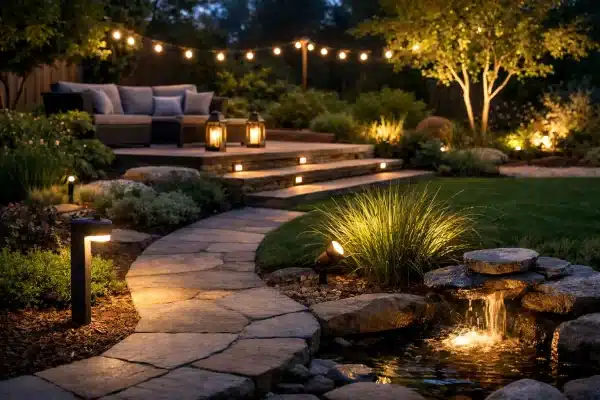
Think in zones. Your immediate outdoor living area needs the most useful illumination, while the far end of the garden can be treated more softly. This gradual fall-off creates depth and makes even a compact garden feel larger. Lighting every corner at the same brightness has the opposite effect – it can flatten the view and make the space feel exposed.
It also helps to decide how often the lighting will be used. A front path may need dependable daily lighting with a sensor or timer. Lights around a dining table might only come on when entertaining. Planting accents can be controlled separately, allowing you to create a more relaxed evening setting without leaving the whole garden illuminated.
Build the scheme in layers
Light the routes first
Safety lighting should be discreet but clear. Low bollards, recessed step lights and carefully positioned wall lights can define a route without shining directly into anyone’s eyes. Aim fittings downwards where possible, especially around changes in level, uneven paving and doorways.
Spacing matters more than sheer quantity. A few well-positioned fittings will guide people naturally along a path; a long line of bright lights can look like a runway. For steps, place the light where it reveals the edge of each tread, not opposite it at eye level. If the garden is accessed from the side of the house, make sure gates, bins and any change in surface are visible too.
Create a welcoming patio or deck
Your main seating area benefits from a warm, flattering pool of light rather than a single powerful floodlight. Outdoor wall lights on either side of doors work well for arrival and everyday use. Add table lamps designed for outdoor use, portable lanterns or low-level fittings around the perimeter to make the space feel more intimate.
Warm white light is usually the strongest choice for dining and relaxing. It complements timber, stone, brick and greenery, and it feels far more inviting than a cool blue-white output. If you are fitting lights close to a table, keep the source shielded or diffused. Nobody wants to spend dinner looking into a bare, bright lamp.
For covered patios, pergolas and garden rooms, LED tape can add a tailored finish beneath benches, handrails, roof edges or shelving. It is particularly effective when the fitting itself stays hidden and the light appears to come from the architecture. A bespoke approach is worthwhile for awkward lengths, curves and built-in joinery, where standard fittings can interrupt a clean design.
Give planting and texture a role after dark
A single uplight at the base of an established tree can become the focal point of the whole garden. The same principle works with sculptural shrubs, ornamental grasses, feature pots and stone walls. Use a narrow beam for a trunk or tall specimen, and a wider, gentler spread for layered planting.
Less is generally more. Choose two or three features that will still look attractive in winter, rather than trying to illuminate every border. Evergreen structure, bark, grasses and textured walls often give the best results. Angle lights carefully so that the beam catches the leaves or surface, not the viewer’s face or a neighbour’s window.
Choose the right fittings for each job
Outdoor lights must cope with the conditions they will face. In Ireland and across the UK, that means rain, wind, damp air and seasonal temperature changes. Check the IP rating before buying. As a useful rule, fittings in exposed areas should have an IP rating suitable for direct rain, while lights positioned close to water features or in more demanding locations need greater protection.
Material affects both appearance and maintenance. Stainless steel can look sharp in a contemporary scheme, but choose a quality finish and expect occasional cleaning in coastal or exposed locations. Powder-coated aluminium offers a modern, low-maintenance option in black, anthracite or softer neutral tones. Brass and copper develop a natural patina, which suits gardens with a more characterful, established look.
There is also a decision between mains, low-voltage and solar lighting. Mains-powered fittings offer the most consistent output and are ideal for permanent pathways, wall lighting and larger gardens, but installation should be planned properly and carried out by a qualified electrician. Low-voltage systems can make it easier to add multiple accents across planting beds. Solar has improved greatly and is useful where cabling is impractical, though performance depends on daylight exposure and tends to be less reliable through darker months.
Get the brightness and colour temperature right
Brightness should follow purpose, not habit. Entrance and security areas need enough light to see clearly, but they do not need to be harsh. Decorative garden lighting can be subtler still. If you can see the fitting’s glare before you see what it is lighting, the output is probably too strong or the angle needs adjusting.
For most residential gardens, warm white light around 2700K creates the most comfortable result. It works beautifully with relaxed entertaining spaces and traditional or contemporary landscaping alike. Neutral white can suit a crisp, architectural courtyard or practical working area, but use it sparingly near seating. The cooler the light, the less forgiving it becomes on natural materials and skin tones.
Avoid mixing wildly different light colours. A warm patio wall light beside cool-white path spikes will make the garden feel pieced together. Pick one dominant colour temperature, then use dimming or separate controls to vary the mood.
Controls make a good scheme easier to live with
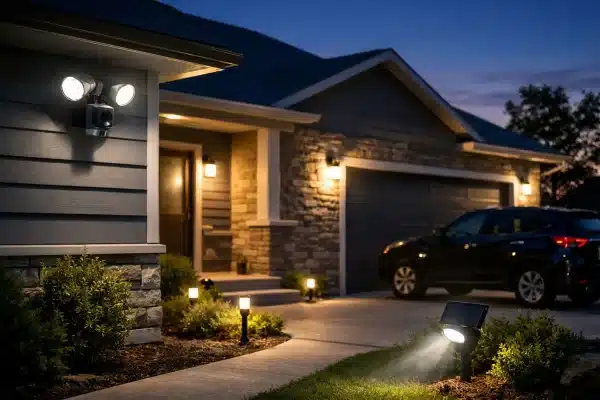
The most attractive lighting plan is one you will actually use. Timers are excellent for front gardens and regular evening routines, while dusk-to-dawn sensors take care of everyday arrival lighting. Motion sensors can be useful by side passages, garages and utility doors, provided they are positioned to avoid constant activation from pets, passing traffic or moving branches.
Smart controls give more flexibility for entertaining. You might have one setting for coming home, another for outdoor dining and a low-level late-night option that leaves only paths and a feature tree lit. Keep practical and decorative lighting on separate circuits where possible. This means you can enjoy the atmosphere without wasting energy or lighting the garden more than necessary.
Common garden lighting mistakes to avoid
The most common mistake is treating brightness as a substitute for design. Floodlighting the entire garden may feel secure at first, but it removes shadows, obscures focal points and can disturb neighbouring homes and wildlife. Direct the beam only where it is needed, use shields where appropriate and switch lights off when they are not serving a purpose.
Another is installing fittings without considering maintenance. Choose locations where lamps, lenses and fittings can be safely reached for cleaning. Trim back planting that may cover spike lights or trap moisture around fittings. If a tree or hedge is still growing, allow for its future size before fixing a spotlight in place.
Finally, do not leave wiring as an afterthought. Plan cable routes before paving, decking or new borders are complete. It is simpler, neater and often more cost-effective than lifting finished surfaces later. For permanent external electrical work, use a qualified electrician and select fittings designed specifically for outdoor installation.
A well-lit garden does more than extend the hours you can spend outside. It gives your home a warmer arrival, turns familiar planting into an evening feature and makes every patio dinner feel that little bit more special. Begin with one area you use most, light it beautifully, and let the rest of the scheme grow from there.